
Start with the essentials
Leaf enzymes can continue changing compounds after harvesting. Fixation uses timely heat to reduce relevant enzyme activity and control further oxidation, while also changing moisture, smell and texture. Understanding green tea begins with how heat reaches the leaf.
This article compares pan and steam heat transfer, distinguishes equipment temperature from leaf temperature and connects duration, material and later drying with colour, aroma and processing defects.
Three key points
- Heat manages reaction progressTemperature and duration work with leaf size, moisture and loading.
- Equipment and leaf temperatures differContact and transfer determine how a heat source affects material.
- Later stages still matterShaping and drying follow oxidation control to complete the product.
Connect the process with the tea
Compare clearly identified pan-fixed and steamed green teas through aroma, taste and infused leaves. Add material and drying information; one aroma cannot reveal an exact leaf temperature or processing duration.
The green-tea process
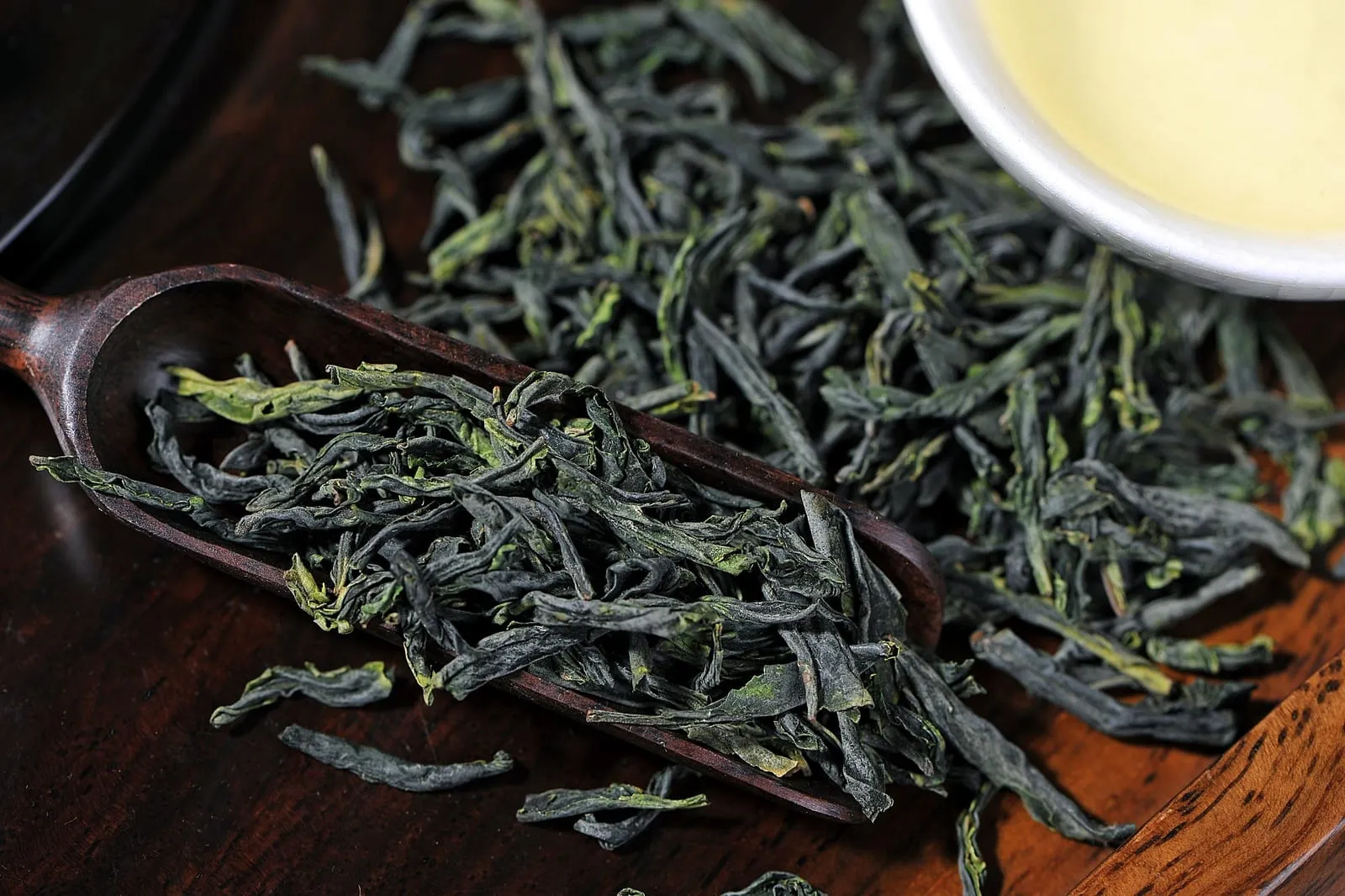
Fixation is the master switch for green tea quality. PPO and peroxidase (POD) catalyse the enzymatic oxidation of catechins. Rapid heating disrupts these enzymes’ protein structure and deactivates them, halting the oxidation cascade. When leaf temperature enters the high-heat zone above roughly 80 °C (176 °F) and exposure is sufficient, most PPO activity falls rapidly; the result still depends on heat transfer, leaf moisture and uniformity. In the study cited here, some PPO activity remained after steam fixation, and later drying reduced residual activity further[1][2].
“Green tea isn’t unchanged — it’s change with the pause button pressed.”
Biochemistry: how heat silences the enzymes
The enzymatic oxidation cascade runs as follows[4]:
Pan-Firing Thermal Inactivation: Leaf Temperature vs. PPO Activity
Step through the 3 pan-firing stages or play the sequence to inspect contact heat transfer, moisture venting, and rapid PPO inactivation.
About this diagram & its limits
Fixation heat-transfer and range illustration · Values are teaching bands for the stated pan/drum scenario. Surface setting is not leaf temperature, and outcomes also depend on time, moisture, loading and heat uniformity; this is not a production recipe.
Turgid, glossy, resilient; surface water droplets visible
Fresh leaves enter the hot wok; leaf temperature remains below the rapid-inactivation threshold (<60 °C). Prompt agitation is required to prevent bruised tissues from developing red-leaf defects.
Heat, duration and moisture must be coordinated. Higher equipment temperatures cannot substitute for prompt agitation, even feeding, or timely cooling.
- Substrates: fresh leaves are rich in catechins (EGCG, ECG, EGC) and simple phenols.
- Catalysis: PPO uses molecular oxygen to oxidise catechins to o-quinones; POD can also participate when H₂O₂ is present.
- Polymerisation: quinones are highly unstable and polymerise into theaflavins, thearubigins and even theabrownins — the pigments that darken black and oolong teas.
- Fixation intervention: high heat (pan-firing leaf temperatures 80–100 °C; steaming at 100 °C) rapidly disrupts the PPO/POD structure, inactivating the active site and truncating the oxidation chain within minutes[1].
Öztürk et al. (2016) showed that fixation reduces PPO activity by over 90% and POD activity even more; steam fixation leaves more residual PPO than pan-firing, indicating that dry-contact heat is more effective at complete deactivation[1].
Enzyme characteristics and heat-inactivation kinetics
PPO and POD are metalloprotein oxidoreductases whose activity depends on temperature and pH[4]:
- Optimum temperature. Leaf PPO works best around 25–35 °C; activity drops quickly above 60 °C and most is lost above 80 °C.
- Optimum pH. PPO is most active around pH 5.0–7.0. Fresh leaf sap is naturally acidic, so once the cell is damaged the enzyme is already in a favourable range — which is why bruised leaf reddens so fast.
- Heat stability is condition-dependent. Leaf source, isoenzyme and assay conditions change the apparent heat stability of PPO and POD. In the Turkish green-tea study cited here, PPO was harder to eliminate completely; production guidance should not assume one universal order of inactivation.
Heat inactivation is not instantaneous — it follows an exponential decay as temperature and time increase. In pan-firing the pan may be 200–300 °C, but that is not the leaf temperature. Leaves touch the hot metal for only a few seconds before being tossed and cooled, so the actual leaf temperature rises quickly to roughly 80–100 °C. If the batch is too large or tossing is uneven, some leaves will be under-heated and “under-fixed”[2][5].
Heat-transfer comparison: pan-firing, steaming, drum and microwave
Different fixation methods differ in how heat reaches the leaf, and that directly affects enzyme inactivation, colour and aroma[1][2][5].
| Fixation method | Heat-transfer mechanism | Leaf-temperature character | Aromatic direction | Typical examples |
|---|---|---|---|---|
| Pan-firing | Metal-to-leaf contact, dry heat | Fast rise, leaf 80–100 °C | Chestnut, bean, fresh | Longjing, Biluochun |
| Steaming | Steam latent heat, moist heat | Even, ~100 °C | Seaweed, vivid green | Japanese sencha, gyokuro |
| Drum fixation | Drum-wall conduction + hot air | Controllable, continuous | Fresh, chestnut | Bulk green tea |
| Microwave + hot air | Microwave volumetric heating + hot air | Fast internal, even heating | Fresh, slight toast | Experimental premium lines |
- Pan-firing. Direct contact with a hot metal surface drives off low-boiling grassy volatiles and triggers Maillard and sugar-amino-acid reactions, producing pyrazines and pyrroles — the source of Longjing’s chestnut/butter-bean note.
- Steaming. Steam transfers heat evenly and quickly, so chlorophyll is preserved better and the liquor stays greener. The moist heat also breaks down S-methylmethionine into dimethyl sulfide (DMS), giving steamed teas their characteristic seaweed-like note.
- Microwave. Polar molecules (mainly water) oscillate and generate heat throughout the leaf, giving fast, volumetric enzyme inactivation. Used alone it can under-develop aroma, so it is usually combined with hot air[2].
- Drum / continuous fixers. The main route for mass-market green tea: temperature, rotation speed and airflow are controllable, giving consistency but usually less aromatic finesse than hand pan-firing.
Rotary Drum Continuous Fixation: Cascading Curtains & Forced Venting
Step through the 3 rotary-drum stages or play the sequence to observe continuous hopper feeding, helical-flight leaf curtains, and forced moisture exhaust.
About this diagram & its limits
Fixation heat-transfer and range illustration · Values are teaching bands for the stated pan/drum scenario. Surface setting is not leaf temperature, and outcomes also depend on time, moisture, loading and heat uniformity; this is not a production recipe.
Loose, resilient leaves feeding smoothly through the intake hopper
Fresh leaves slide into the heated rotating cylinder from the hopper, engaging the initial flight baffles as surface moisture starts evaporating.
Heat, duration and moisture must be coordinated. Higher equipment temperatures cannot substitute for prompt agitation, even feeding, or timely cooling.
The colour science: why fixation “keeps green”
Green tea’s colour comes from chlorophyll. Fresh leaves contain chlorophyll a and chlorophyll b; their ratio sets the green tone. Under moist heat or acidic conditions the magnesium ion at the centre of the chlorophyll molecule is replaced by hydrogen, forming pheophytin, which shifts colour from fresh green to brown-olive. If the ester bond is also hydrolysed, pheophorbide forms, giving a more yellow-brown hue[4].
During fixation:
- Rapid heating inactivates the enzymes and reduces enzymatic browning.
- Prompt cooling (the tossing motion in pan-firing) prevents the leaves from stewing in their own heat, limiting pheophytin formation.
- Moisture control matters: after fixation the leaves are still hot, and if they are piled before cooling, residual heat drives further non-enzymatic reactions that yellow the leaf.
So “keeping green” is not just a colour issue — it is the result of temperature, time and cooling working together.
Fixation and drying as a relay
Fixation does not do the whole job. Three reasons why drying is still essential:
- Residual activity can remain. Short fixation does not necessarily eliminate PPO and POD at the same rate or completely. Later drying reduces residual activity further, with the extent depending on the tea and drying conditions.
- Moisture remains high. After fixation the leaves still contain about 55–60% water, which is enough medium for residual enzyme activity and microbial growth. Drying brings moisture down to 5–7%, truly “locking” the tea.
- Aroma needs drying to develop. Fixation removes grassy notes and preserves the green base; the finer chestnut, floral and baked notes develop during drying through glycoside hydrolysis and Maillard reactions.
Think of fixation as pressing the shutter and drying as developing and fixing the photograph — both are needed for a lasting image.
Key compound dynamics
| Compound | Fresh leaf | Change after fixation | Quality significance |
|---|---|---|---|
| Catechins (EGCG, etc.) | High | Slight thermal degradation, but mostly preserved | Freshness, astringency, antioxidants |
| Chlorophyll | High | Partly converted to pheophytin | Determines leaf and liquor greenness |
| Amino acids | Medium | Slightly increased by mild protein hydrolysis | Freshness, sweetness |
| Soluble sugars | Medium | Stable or slightly increased | Sweetness, body |
| Glycosidically bound aroma precursors | High | Partly hydrolysed, released or transformed | Base for fresh, chestnut and floral notes |
| Grassy volatiles (hexanal, leaf alcohol) | High | Largely driven off | Removes green/grassy off-notes |
| PPO/POD activity | High | Sharply reduced | Halts enzymatic oxidation |
Reference: Qiu et al. (2022) found that after fixation chlorophyll, protein and lipid metabolites decrease, while amino acids, soluble sugars and glycosidic aroma precursors increase, laying the biochemical foundation for green tea’s freshness[3].
Parameters and quality defects
These are common ranges, adjusted in practice for leaf condition, equipment and style[5].
| Step | Parameters | Role |
|---|---|---|
| Spreading | room temp, 4–8 h, ~10–15% water loss | sheds some water, softens the leaf; slight enzyme activity |
| Fixation | pan ~200–300 °C, leaf temp 80–100 °C, 1–3 min [1][2] | heat deactivates PPO/POD, halts oxidation, fixes the green; drives off grassy notes |
| Rolling | light→medium→heavy, 5–30 min | ruptures cells, shapes the leaf, aids extraction |
| Drying | bake / pan / sun, to 5–7% moisture [1] | ends residual reactions, sets shape, develops aroma (Maillard) |
Under-fixation causes:
- residual enzyme activity → red edges, dull yellow liquor;
- grassy volatiles not removed → green/grassy aroma;
- too much moisture → storage-related staleness.
Over-fixation causes:
- excessive chlorophyll degradation → grey-yellow dry leaf, yellow-brown liquor;
- scorched edges → smoky/burnt off-notes;
- loss of amino acids and sugars → reduced freshness.
Representative styles
| Style | Fixation method | Key difference | Flavour direction |
|---|---|---|---|
| Longjing (pan-fired) | high-temperature pan-firing | tossing, pressing, covering motions carry leaf temperature quickly past the enzyme optimum | toasted chestnut, fresh and sweet |
| Enshi Gyokuro (steamed) | steam | even steam penetration, gentler temperature rise | seaweed-like, vivid green |
| Huangshan Maofeng (baked) | pan-fired then baked | drying dominated by baking with a gentle gradient | clear high aroma, fresh and mellow |
| Japanese sencha | steam + strong firing/rolling | deep steaming gives a deeper green leaf and liquor | marine, umami-forward |
The steamed-vs-pan-fired aroma divide has a molecular footnote: the “seaweed” note of steamed green tea comes largely from dimethyl sulfide (DMS), produced as S-methylmethionine breaks down in the moist heat of steaming; the strong heat of pan-firing and roasting drives most DMS off, which is why the seaweed note is faint in pan-fired green teas[4].
Fixation method, residual enzyme activity and aroma
| Fixation method | PPO residual trend | POD residual trend | Typical aroma risk | Quality point |
|---|---|---|---|---|
| Pan-firing | Low | Low-medium | Scorched edges, smoky/burnt notes | Toss and cool to avoid stewing |
| Steaming | Medium | Medium | Over-strong seaweed or grassy note | Control steam amount and time |
| Microwave + hot air | Low | Low | Slightly raw or flat aroma | Pair with hot air to develop aroma |
| Drum | Low–medium | Low–medium | Monotone, slight stewed note | Control drum temperature and batch size |
This table reminds us that there is no single “correct” temperature — only a choice matched to the raw leaf and the later steps. Tender buds fear high heat; mature leaves need more heat to fix through.
Common misconceptions
- “Fixation means drying the leaf.” Fixation only inactivates enzymes and partly removes water; rolling and drying still follow. Drying is what actually makes the leaf shelf-stable.
- “The hotter the pan, the better.” A hot pan does not equal hot leaves; blind high heat scorches the surface while the inside remains under-fixed.
- “Steaming is always better than pan-firing.” The two methods point in different aromatic directions: steaming gives green freshness, pan-firing gives chestnut depth. Neither is universally superior.
- “After fixation the leaf cannot oxidise any more.” Under-fixation or later damp storage can leave enough active enzyme to cause colour and aroma deterioration.
See also
- Leaf chemistry — what is in the leaf before fixation
- Longjing green tea — the fixation science behind Longjing’s chestnut note
- Huangshan Maofeng — a baked green tea’s fixation and drying balance
Flavour sketch
Green tea · flavour sketch
Tea Science · core comparison
| Dimension | Green tea (fixation) | Black tea (oxidation) | Oolong (shaking/withering) |
|---|---|---|---|
| Transformation pattern | Early heat suppresses enzymatic oxidation | Extensive enzymatic oxidation (not a universal measured percentage) | Controlled, local and partial enzymatic oxidation |
| Dominant force | heat deactivation of enzymes | PPO/POD enzymatic oxidation | mechanical damage + enzymatic oxidation |
| Core products | preserved catechins, chlorophyll | theaflavins, thearubigins | floral terpenes, some theaflavins |
| Liquor colour | clear green | bright red | golden to orange |
For the full six-tea-class comparison, see The Science of Tea: From Leaf to Six Tea Types.
References
- R-060 — Öztürk, B., et al. (2016). Change of enzyme activity and quality during the processing of Turkish green tea. LWT-Food Science and Technology, 65, 318–324. https://www.sciencedirect.com/science/article/abs/pii/S0023643815300852
- R-061 — 葛庆丰 等 (2011). 绿茶微波热风耦合杀青工艺研究. 食品科学, 32(12), 196–199. https://www.spkx.net.cn/EN/abstract/abstract23448.shtml
- R-029 — 宛晓春 主编 (2003).《茶叶生物化学》(第3版). 中国农业出版社. ISBN: 978-7109066274.
- R-031 — 施兆鹏, 夏涛 主编 (2016).《茶叶加工学》(第3版). 中国农业出版社. ISBN: 978-7109214347.
- R-203 — Wang, Y., et al. (2021). Targeted metabolomics reveals dynamic changes during the manufacturing process of Yuhua tea, a stir-fried green tea. Beverage Plant Research, 1, 6. https://doi.org/10.48130/bpr-2021-0006
Article Knowledge Network
Explore the connections between the teas, processes and flavours in this article.