
Start with the essentials
Green, white, yellow, oolong, black and dark teas are primarily distinguished by key processing changes. Fixation, withering and drying, yellowing, leaf working, enzymatic oxidation and microbial transformation provide their main reference points.
This article explains oxidation, moist heat and microbial activity, then addresses scented and compressed teas. Following what happens to fresh leaves makes the six names a useful framework before considering colour.
Three key points
- Follow defining stepsTheir sequence and combination identify the manufacturing approach.
- Interpret fermentation in contextBlack-tea oxidation differs from microbial transformation in dark tea.
- Other terms describe additional layersCompression concerns form, while flower scenting concerns further processing.
Start by identifying the category
Choose three familiar teas and name a defining processing step for each. Compare liquor and infused leaves, then consult material and manufacturing information when colour differs from expectations.
1. Why classify by craft
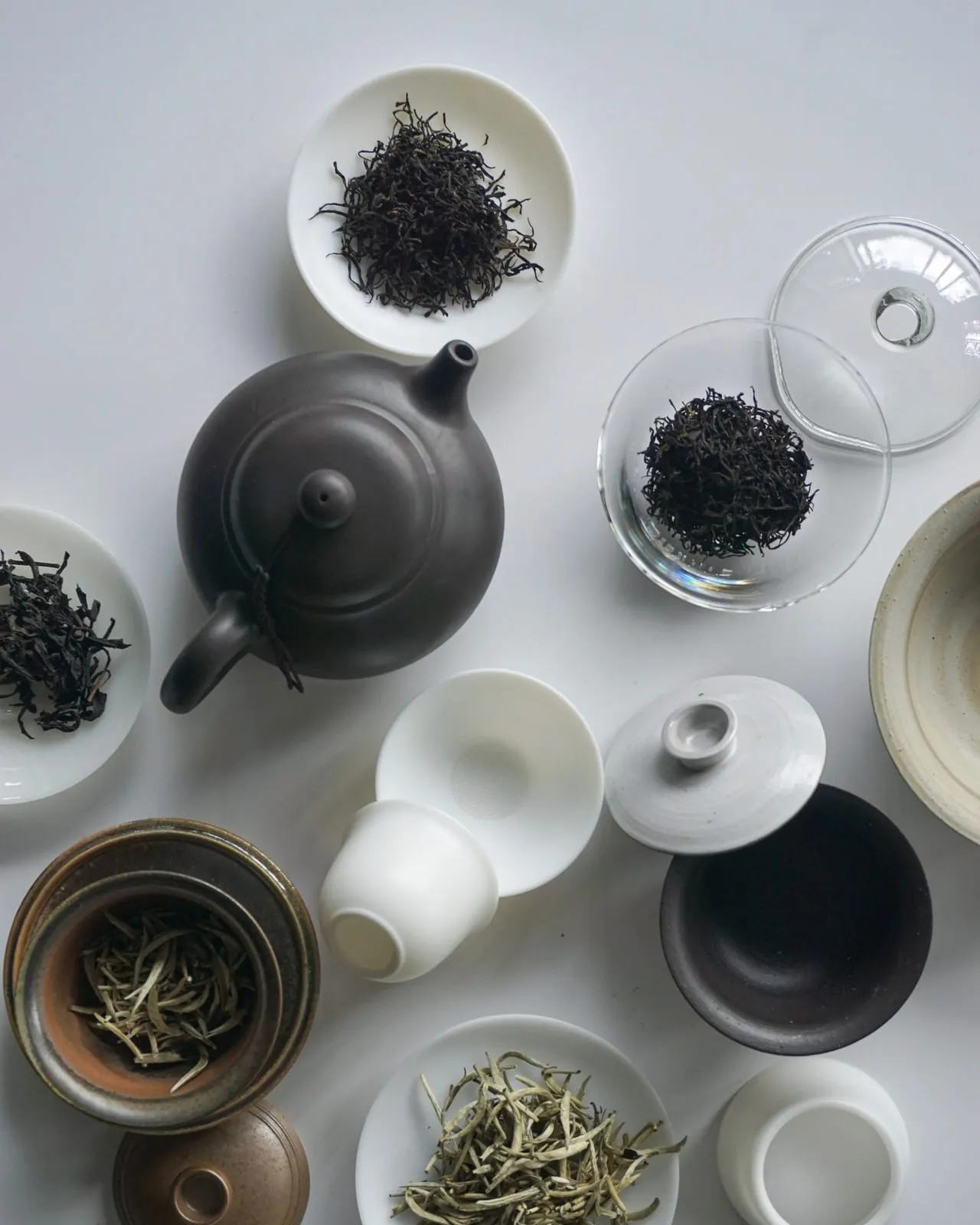
The “six categories” framework, formally proposed by tea scientist Chen Chuan in 1979 (see section 8 below), is organised by processing method (and the resulting quality) rather than by leaf colour or origin[2]. Its strength is that it captures the essence — tea’s endless variety stems from different ways of handling enzymes and oxidation[3].
Classifying by colour is clearly limited: black tea is not necessarily black, green tea not always green, and white tea not literally white. Classifying by origin cannot explain why the same district produces both green and black tea. Only classification by craft lets us group Longjing, Biluochun and Huangshan Maofeng as green tea, Keemun and Dianhong as black tea, and Tieguanyin and Da Hong Pao as oolong — they share key processing steps, not colour or place name[2].
2. The underlying framework: oxidation, moist heat and microbes
If we place the six categories in a three-dimensional space, the three axes are:
Click a tea to read the science behind it
Two "atypical-oxidation" paths
Positions show typical processing tendencies only: they are not measured “oxidation percentages” or category/grade thresholds. Actual extent varies with cultivar, leaf material, season and craft. Moist-heat yellowing and microbial post-fermentation are shown separately.
- Degree of enzymatic oxidation: from green tea (inhibited) to white (light) to oolong (partial) to black (extensive).
- Moist-heat treatment: yellow tea adds a men-huang step after fixation, using moist heat to create non-enzymatic yellowing.
- Microbial involvement: dark tea introduces microbes through wodui after primary processing for post-fermentation.
Yellow and dark tea stand apart because they cannot be placed neatly on the “oxidation axis” alone: yellow-tea yellowing is mainly non-enzymatic, and dark tea’s core is microbial post-fermentation. This framework also explains why “oxidation percentage” cannot precisely describe all tea categories — for yellow and dark tea the key transformation is not an enzymatic-oxidation percentage at all[3].
3. The six categories, side by side
Each category is defined by a chain of steps, usually with one key step that determines its essence. Click a name to read the science behind it:
Camellia Tea Knowledge Base · by 茶食新知 | Updated 2026-08
4. Category by category
Green tea
Key step: fixation (high-heat inactivation of PPO/POD).
Green tea’s core idea is “stop oxidation early”. Fresh leaves are rapidly heated by pan-firing, steaming, microwave or drum to 80–100 °C, inactivating polyphenol oxidase and peroxidase and preserving catechins, chlorophyll and amino acids. Aromas centre on green, chestnut, bean and seaweed notes; the taste is brisk, slightly bitter-astringent and sweet. Examples: West Lake Longjing, Biluochun, Huangshan Maofeng, Japanese sencha [3][4].
White tea
Key step: withering (long, slow water loss + light enzymatic oxidation).
White tea is neither fixated nor rolled. Leaves are withered for 36–72 hours at 15–35 °C and 60–80% RH. Cells stay intact, oxidation is very light; protein hydrolysis raises free amino acids and glycosidic precursors release downy and floral aromas. The finished tea is downy, sweet, brisk and pale apricot in the cup. Examples: Baihao Yinzhen (Silver Needle), Baimudan (White Peony), Shoumei [5][6].
Yellow tea
Key step: men huang (moist-heat non-enzymatic yellowing after fixation).
Yellow tea adds a “men huang” step on top of green-tea processing: hot, fixated leaves are piled or wrapped while still warm and moist. Under moist heat chlorophyll degrades, polyphenols oxidise lightly, and sugar-amino-acid reactions create yellowing products. The leaf is yellow-green, the liquor apricot-yellow, and the taste mellow-sweet and gentle, often with a “toasty” or young-corn note. Examples: Junshan Yinzhen, Mengding Huangya, Huoshan Huangya [3][7].
Oolong (qing tea)
Key step: zuoqing (repeated shaking–resting, partial oxidation + stress-induced aroma).
Oolong takes the middle road. Repeated shaking bruises the leaf edges, allowing limited enzymatic oxidation that creates “green leaf with red edge”; mechanical damage, dehydration and cool-night stress also induce floral and fruity volatiles. Fixation then stops oxidation, followed by rolling, drying and often roasting. The tea is richly floral-fruity, full and smooth. Examples: Tieguanyin, Wuyi rock tea, Fenghuang Dancong, Taiwan oolong [3][8].
Black tea
Key step: oxidation (extensive enzymatic oxidation).
Black tea is withered, rolled to break cells, and allowed to oxidise fully so that PPO/POD turn catechins into theaflavins, thearubigins and theabrownins, before drying arrests the reaction. The liquor is bright red, the taste sweet-mellow and brisk, and the aroma sweet-floral, fruity or malty. Examples: Keemun, Dianhong, Lapsang Souchong, Assam [3][9].
Dark tea
Key step: wodui (microbial post-fermentation).
Dark tea hands the lead role to microbes. After fixation, sun-dried maocha is watered, piled and kept warm and humid; fungi such as Aspergillus niger multiply and secrete extracellular enzymes that convert polyphenols deeply into theabrownins, while proteins and fibres partly degrade and soluble sugars increase. The liquor is red-brown, thick and bright; the taste mellow, smooth and aged. Examples: ripe pu-erh, Fuzhuan brick, Liubao, Ya’an Tibetan tea [3][10].
5. Craft and chemistry comparison
| Tea category | Key step | Oxidation / transformation type | Core products | Polyphenol trend | Amino-acid trend | Typical liquor | Typical aroma |
|---|---|---|---|---|---|---|---|
| Green | Fixation | Enzymatic oxidation inhibited | Catechins, chlorophyll, amino acids | High | High | Clear green / yellow-green | Green, chestnut, seaweed |
| White | Withering | Light enzymatic oxidation | Retained catechins, free amino acids | High | High | Pale apricot | Downy, sweet, floral |
| Yellow | Men huang | Moist-heat non-enzymatic yellowing | Pheophytin, yellowing products | Medium-high | Medium-high | Apricot | Toasty, sweet |
| Oolong | Zuoqing | Partial enzymatic oxidation | Partly retained catechins, small theaflavins, floral volatiles | Medium | Medium | Golden–orange-red | Floral, fruity, roasted |
| Black | Oxidation | Extensive enzymatic oxidation | Theaflavins, thearubigins, theabrownins | Low | Medium-low | Bright red | Sweet-floral, fruity, malty |
| Dark | Wodui | Microbial post-fermentation | Theabrownins, soluble sugars | Very low | Low | Red-brown, thick | Aged, woody, fungal-floral |
The trends in the table are relative comparisons among the six categories; actual values vary with cultivar, origin, season and processing parameters.
6. Reprocessed and compressed teas
Beyond the six basic categories are reprocessed teas made from them as raw material — for example flower-scented teas such as jasmine tea, and compressed teas pressed into cakes, bricks or nests. They are not a “seventh category” but extensions of the six[1].
Compressed tea matters not only for shape but also for storage: pu-erh cakes and Fuzhuan bricks reduce the tea’s contact with oxygen, making ageing slower and more uniform; compressed forms were also essential for long-distance transport on the Tea-Horse Road. Scented teas use green, black or oolong tea as a base and absorb floral fragrance through repeated scenting with fresh flowers, creating a composite style in which tea carries flower and flower enhances tea.
7. Borderlines and disputes
The six-category framework is clear, but its borders host some classic “where does it belong?” puzzles:
- Where does raw pu-erh fit? By craft, un-piled raw pu-erh is a sun-dried green tea — the subtle reason it sits under the same “pu-erh” name as ripe tea. The national standard GB/T 22111 handles this from the geographical-indication angle: it defines “pu-erh tea” as a product in its own right and splits it into raw and ripe tea by whether the tea has undergone wodui, running parallel to the six-category framework rather than conflicting with it[8]. A raw pu-erh aged for years turns red in the cup — that is the result of storage transformation, and it does not change the fact that the tea was never piled.
- The two ends of oolong. A lightly processed jade oolong comes close to green tea, while heavily processed ones (like Oriental Beauty) approach black tea — oxidation is a continuum with no absolute percentage thresholds.
- Yellow tea’s independence. When the men-huang step is very light, yellow tea is almost indistinguishable from green tea, and its standing as a separate category has been debated; the yellowing products and quality character produced by men huang are the basis for treating it as a separate category.
- The English terminology “mismatch.” Internationally, black tea means China’s red tea, while dark tea is called dark tea — the usage ISO 20715 follows[7]. Translating “dark tea” literally back as black tea points at a completely different product.
None of these disputes undermines the framework’s usefulness: classification is a tool for understanding tea, not an ID card for every single leaf.
8. How to use the six-category framework
Mastering the six-category framework helps with learning about tea, buying tea, brewing tea and storing tea:
- Learning: understand the craft logic first. When you see a tea, decide which category it belongs to, then look at how its key step is executed.
- Buying: read labels and marketing claims more critically. Statements such as “raw pu-erh is dark tea” or “white tea is unfermented” can be checked against this framework.
- Brewing: choose water temperature and vessel by category. Green and white teas usually prefer lower temperatures; oolong, black and dark teas can start hotter; compressed teas often benefit from a rinse.
- Storing: green tea is best kept fresh, sealed and cool, and consumed within the year; white tea, raw pu-erh and dark tea can age in dry, ventilated conditions; black tea and most oolongs have more limited ageing value, depending on the specific tea.
9. How the system came to be
Today’s “six categories” were not always with us. Earlier schemes classified tea by colour (red vs. green tea) or by origin (Wuyi, Longjing) — useful labels, but they stayed on the surface. In 1979, tea scientist Chen Chuan formally proposed the six-category system in his paper The Theory and Practice of Tea Classification (Tea Industry Bulletin, 1979, issue Z1): green, yellow, dark, oolong, white and black tea, organised by processing method and resulting quality, with the oxidation of tea polyphenols (flavanols) as the backbone, and with an eye to the historical order in which the categories emerged[2][6]. That framework captured the essence, and it was then standardised step by step:
- National standard: GB/T 30766-2014 Tea Classification established the six basic categories plus reprocessed teas, defined by processing technique and product characteristics[4].
- International standard: In April 2023, ISO 20715:2023 Tea — Classification of tea types, led by a team at Anhui Agricultural University headed by Wan Xiaochun and jointly developed with experts from many countries, was published. Built on the Chinese framework, it confirmed green, black, yellow, white, oolong and dark tea as the internationally recognised types, and defined characteristically Chinese process terms such as shaping, men huang and piling[7].
From a 1979 paper to a national standard to an international one — the Chinese way of classifying tea travelled the full route[6][4][7].
10. Common misconceptions
- “The six categories are grouped by colour.” No. The basis is processing method and resulting quality; colour is only an incidental appearance for some categories.
- “Oxidation degree can be expressed as an exact percentage.” There is currently no unified, reproducible “oxidation percentage” for the six categories; percentages such as 20% or 80% are only rough experiential descriptions.
- “Black tea is fully oxidized and oolong is half-oxidized.” These phrases are memory aids, not rigorous: black tea is extensive enzymatic oxidation, oolong is partial enzymatic oxidation, and the degree varies continuously.
- “Raw pu-erh is also dark tea.” Strictly speaking, no. Freshly made raw pu-erh is fundamentally a sun-dried green tea. While it undergoes slow non-enzymatic oxidation over decades of dry storage, it never undergoes artificial wet-piling (wodui); only pile-fermented ripe pu-erh (shou pu’er) belongs to the dark tea (hei cha) category.
- “White tea is unfermented.” White tea does undergo light enzymatic oxidation, just very little.
- “Yellow tea is just green tea with an extra step.” Men huang is indeed added to green-tea processing, but the moist-heat yellowing products and quality character it creates justify yellow tea as a separate category.
Further reading · the science of each craft
- Green-tea fixation · White-tea withering · Yellow-tea yellowing
- Oolong zuoqing · Black-tea oxidation · Dark-tea wodui
References
- R-031 — 施兆鹏, 夏涛 主编 (2016).《茶叶加工学》(第3版). 中国农业出版社. ISBN: 978-7109214347.
- R-030 — 陈宗懋 主编 (2000).《中国茶叶大辞典》. 中国轻工业出版社. ISBN: 978-7501925094.
- R-064 — Sarkar, S., Chowdhury, A., Das, S., Chakraborty, B., Mandal, P., & Chowdhury, M. (2016). Major tea processing practices in India. International Journal of Bioassays, 5(11), 5143–5150. https://doi.org/10.21746/ijbio.2016.11.0015
- R-067 — GH/T 1115-2015.《西湖龙井茶》(West Lake Longjing tea). 中华全国供销合作总社.
- R-071 — GB/T 22291-2017.《白茶》(White tea). 全国茶叶标准化技术委员会(SAC/TC339).
- R-073 — GB/T 32743-2016.《白茶加工技术规范》(Technical specification for white tea processing). 国家质量监督检验检疫总局、国家标准化管理委员会.
- R-101 — GH/T 1242-2019.《六安瓜片茶》(Lu’an Guapian tea). 中华全国供销合作总社.
- R-076 — GB/T 18745-2006.《地理标志产品 武夷岩茶》(Product of geographical indication—Wuyi rock tea). 国家质量监督检验检疫总局、国家标准化管理委员会.
- R-065 — GB/T 13738.2-2017.《红茶 第2部分:工夫红茶》(Black tea—Part 2: Congou black tea). 全国茶叶标准化技术委员会(SAC/TC339).
- R-086 — GB/T 22111-2008.《地理标志产品 普洱茶》(Product of geographical indication—Pu-erh tea). 国家质量监督检验检疫总局、国家标准化管理委员会.
- R-087 — 施兆鹏 主编.《茶叶加工学》. 中国农业出版社. 渥堆工艺章节.
- R-274 — ISO 20715:2023. Tea — Classification of tea types. International Organization for Standardization. https://www.iso.org/standard/68894.html
- R-160 — GB/T 30766-2014.《茶叶分类》(Tea classification). 全国茶叶标准化技术委员会(SAC/TC339).
Article Knowledge Network
Explore the connections between the teas, processes and flavours in this article.