
Start with the essentials
Song diancha uses fine tea powder, staged water additions and whisking to create a foamy drink. Why did dark bowls and the colour and persistence of foam matter? Preparation and the period’s tea competitions offer answers together.
This article follows grinding, paste-making and the seven-pour method, then connects foam with tea painting, competitions and later Japanese matcha practice. Powder, water, movement and bowl provide a frame for the terminology.
Three key points
- Mix in stagesMaking a paste before further water additions has a different purpose from adding all the water at once.
- Foam reflects the processPowder condition, pouring and whisking shape its appearance; the bowl helps people observe it.
- Competition has a contextHistorical standards illuminate both connections and changes between diancha and modern matcha.
Follow the main thread
Connect the purposes of paste-making, pouring and whisking before judging the foam. Compare powder, tools and movements with matcha while keeping their historical and ceremonial settings distinct.
Why the Song Dynasty: Social and Aesthetic Soil
The ascendancy of whisked tea in the Song was no accident; it arose from the convergence of political, economic and cultural forces.
The Tribute-Tea System and Dragon-Phoenix Cake Tea
In the early Northern Song, the court established the Beiyuan tribute tea gardens in Jianzhou (modern Jian’ou, Fujian) to produce the finest cake tea for the imperial family. The highest grade, dragon-phoenix cake tea, was pressed in silver moulds bearing dragon and phoenix motifs and gilded with gold leaf; a single cake could be worth hundreds of thousands of cash[1]. This extreme tribute system drove ever-greater refinement in tea manufacture: the cakes had to pass through steaming, pressing, grinding into paste, moulding and roasting, yielding a product as hard as stone and lustrous black.
Before drinking, the cake was ground fine in a tea mill and then sifted through a tea sieve to obtain an extremely fine powder. Song connoisseurs insisted that “a fine sieve lets the tea float; a coarse sieve lets the water float”—the fineness of the powder directly governed foam formation and stability during whisking[2]. This pursuit of raw-material precision supplied the material foundation for whisked tea.
Literati Taste and “Tea Flourished in the Tang, Reached its Zenith in the Song”
Song literati elevated tea drinking from everyday refreshment to spiritual cultivation. Fan Zhongyan, Ouyang Xiu, Su Shi and Huang Tingjian all left tea poems; Mi Fu’s Spring Mountains and Auspicious Pines is also connected to tea affairs. Emperor Huizong himself wrote the Treatise on Tea (Daguan chalun), systematically expounding the way of whisked tea and incorporating tea into the imperial aesthetic system[2].
“Tea, as a thing, captures the elegance of Ou and Min and the spiritual endowment of mountains and rivers… Subtle, serene, pure and quiet, it is lofty in charm and leads to stillness.”
— Emperor Huizong, Treatise on Tea · Preface[2]
This aesthetic of “lofty charm leading to stillness” made whisked tea not merely a gustatory experience but a synthesis of visual and spiritual art. The snowy foam, the black tea bowl and the delicate tea froth art together formed a distinctive visual language of Song tea culture.
Zen and Tea: Monastic Tea Rites
Zen Buddhism flourished in the Song, and tea served a dual role in monasteries: keeping monks alert during meditation and receiving guests with ritual propriety. Zen monks offered whisked tea to the Buddha and served it to visitors, developing rigorous monastic tea rites. In the Southern Song, Japanese monks such as Eisai and Nanpo Shomyo travelled to Song China to study Zen and brought back both the dharma and the whisked-tea method, becoming the direct source of Japanese matcha[3].
From Cake Tea to Powder: Grinding and Sifting
The first step in whisked tea is converting the cake into an extremely fine powder. This process, called “grinding and sifting,” determines the success of everything that follows.
Roasting and Grinding
Cake tea easily absorbed moisture during storage, so before use it was gently roasted in a tea roaster. Cai Xiang’s Tea Record notes: “If tea has been stored for years, its fragrance, colour and flavour all turn stale. Place it in a clean vessel and scald it with boiling water, scraping away one or two layers of greasy coating… then grind it fine.”[1] Roasting dispels stale odours and makes the cake brittle enough to grind.
Grinding was done with a tea mill—a silver or iron trough and wheel that reduced the cake to grains the size of millet. Song writers stressed that grinding must be “forceful and swift,” because frictional heat could drive off aromatic volatiles[1].
Sifting: Fineness Decides the Foam
The ground fragments were passed through a tea sieve woven from Shu brocade or silk gauze with a very high mesh count. Emperor Huizong’s Treatise on Tea emphasises: “A fine sieve lets the tea float; a coarse sieve lets the water float.”[2] The finer the powder, the larger its specific surface area and the more easily it remains suspended in water; at the same time, fine particles more readily entrap air to form stable bubbles—the physical basis of whisked-tea foam.
Modern research shows that particle-size distribution significantly affects foam stability: particles in the 10–50 μm range most readily form stable adsorption layers at the air–water interface. Moreover, tea saponin is a natural surfactant that lowers surface tension, promotes bubble formation and delays bubble coalescence[4].
Paste Preparation: Water and Powder First Meet
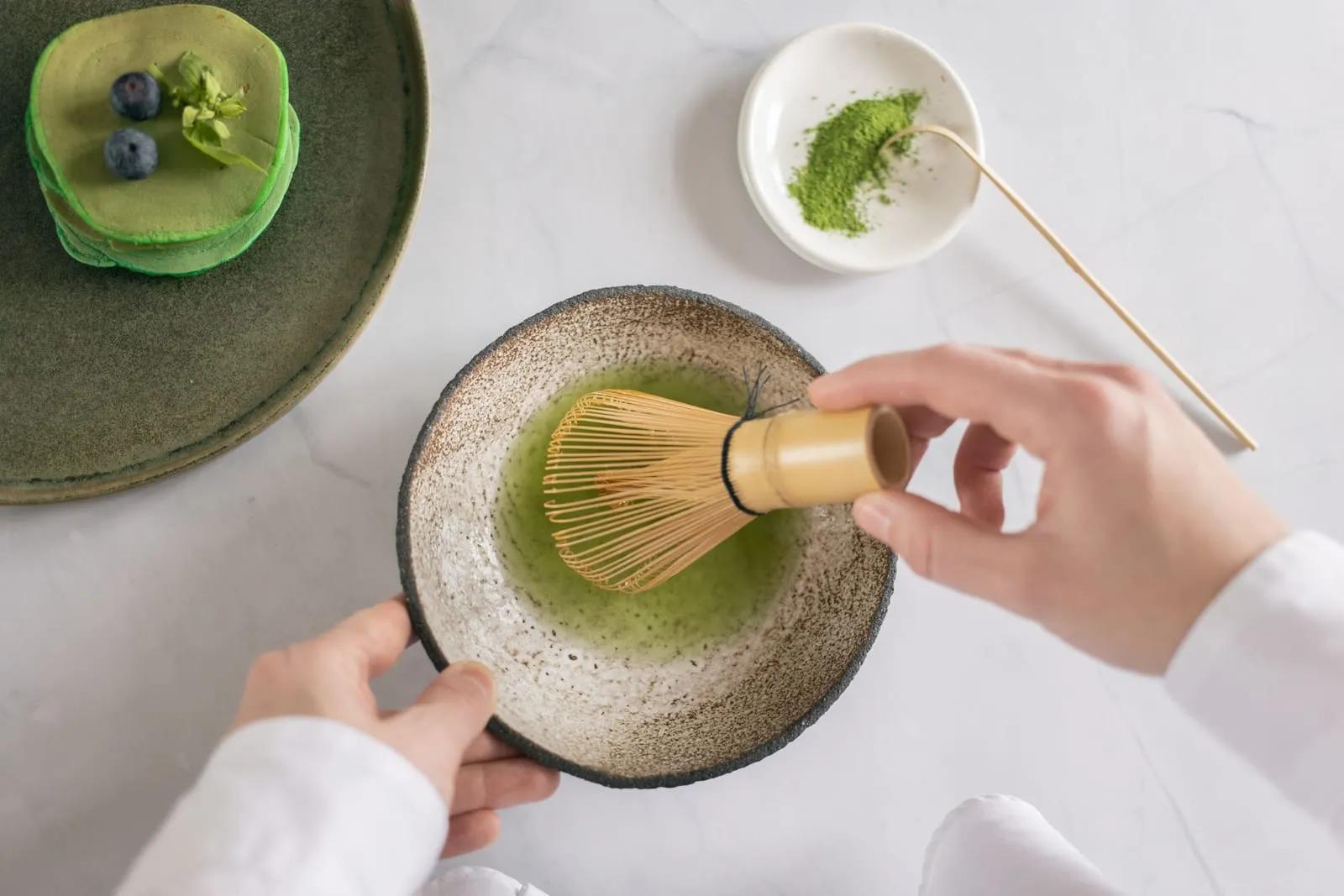
The sifted powder was placed in a tea bowl, and a small amount of boiling water (about 5–10 ml) was added. The whisk or a tea spoon was used to blend the powder into a thick paste. This step, called paste preparation (tiao gao), ensures the powder is fully wetted and dispersed, preventing lumps when more water is added later. The paste should be “like melted glue”—a prerequisite for successful whisking[2].
The Seven-Pour Method: The Apex of Craft
Emperor Huizong’s Treatise on Tea devotes a chapter to the “Seven Pours,” breaking the process of adding water and beating into seven stages, each with its own water volume, pouring manner and whisking force. This is the most systematic and precise whisked-tea tutorial in ancient Chinese tea literature[2].
Emperor Huizong’s Seven-Pour Whisking Lab
Switch pour stages or drag the slider to watch foam evolve from paste to snowy bloom inside a Jian ware bowl
A small stream of boiling water circles the inner wall of the Jian bowl; light whisk strokes disperse the thick tea paste into early sparse bubbles.
The interactive simulation above lets you experience Song whisked tea: switch stages or drag the “Water Pour Count” slider to watch the foam inside the Jian ware bowl evolve from paste to snow-like froth. Each of the Seven Pours is a precise interplay of hand technique and physics.
The Seven Pours
| Pour | Water volume | Pouring method | Whisking technique | Foam evolution |
|---|---|---|---|---|
| 1st | Small amount | Poured around the bowl rim | Light beating to disperse the paste | Colour turns milky white; tiny bubbles appear |
| 2nd | Slightly more | Poured directly onto the tea surface | Faster beating, up and down | Foam rises; colour grows whiter |
| 3rd | More again | Swirled around the bowl | Even, forceful beating | Foam grows fuller; surface slightly domes |
| 4th | A little more | Slightly wider pour | Lighter beating to judge colour | Froth thickens; white foam becomes dense |
| 5th | Increased | Pour must not be rushed | Free beating, aiming for uniformity | Foam rich and snowy white |
| 6th | Nearly full | Slow pour to finish | Gentle circling with the whisk to even the foam | Fine, long-lasting froth |
| 7th | Bowl full | Light finishing pour | Light, even strokes to settle the surface | Snow-foam and milky flower—plump and serene |
Parameters are representative ranges; actual results vary with powder fineness, water temperature, water hardness and the tea master’s technique[2].
The Physics of Whisking: How Foam Forms
The core physical process of whisked tea is foam formation. As the whisk beats the tea liquid at high speed, it generates shear forces that entrap air, forming bubbles. Meanwhile, tea-powder particles and tea saponins adsorb at the air–water interface, creating a stabilising layer that prevents bubbles from coalescing and bursting[4].
From the perspective of bubble dynamics, foam stability depends on three factors:
- Surface tension: Surfactants such as tea saponins lower surface tension, making bubbles easy to form and hard to rupture;
- Interfacial viscosity: Polysaccharides and proteins in the powder form viscous films on bubble surfaces, increasing mechanical strength;
- Drainage rate: Gravity pulls liquid out of the foam, thinning the lamellae until they break. Uniform whisking slows drainage and prolongs foam life[4][5].
Water temperature is also critical. Song whisked tea typically used boiling water (about 95–100 °C), but modern experiments show that 80–95 °C is more favourable for foam stability: excessively high temperatures accelerate saponin degradation and protein denaturation, shortening foam life, while too-low temperatures provide insufficient surfactant activity for bubble generation[4].
Choice of Tea Bowl: Black Glaze and Tea Contests
Song whisked tea favoured black-glazed bowls, above all the Jian ware of Fujian. Jian bowls were fired from iron-rich clay and glaze, developing crystalline patterns such as “hare’s fur,” “oil spot” and “yohen” (iridescent) on a deep black ground. The physical reason is simple: a black background best sets off the white foam, making it easier to judge the quality of the whisked tea[2].
Bowl shape also mattered: a slightly flared rim, steeply angled walls and a narrow, deep base created vortices during whisking that distributed the foam evenly. Moderate wall thickness retained heat without burning the hand. These design details reveal a deep coupling between Song ceramic technology and tea practice[7].
Tea Froth Art and Tea Contests: Competition and Art on Foam
Song Tea Contest (Rim-Cling vs Water Mark) & Froth Art
Switch pour stages to compare winning “Biting the Rim” foam against losing “Water Mark Exposed” and Chabaixi art
A small stream of boiling water circles the inner wall of the Jian bowl; light whisk strokes disperse the thick tea paste into early sparse bubbles.
Tea Froth Art: Painting on Foam
Tea froth art (cha bai xi), also called “water ink painting” or “divided tea,” is the art of using a tea spoon, bamboo pick or drops of clean water to draw patterns on the foam surface. Tao Gu’s Qingyilu records: “Tea became popular in the Tang; in recent times there are those who, by pouring water and moving a spoon with marvellous skill, make the water veins form images of birds, beasts, insects, fish, flowers and plants, as delicate as paintings.”[6]
The principle is similar to latte art: by altering local foam density and thickness, the tea master exploits differences in light refraction to create light-and-dark contrasts. On the fine foam, drops of clean water are applied to break or thin the froth, forming pale lines; or the spoon is used to push foam together, creating raised patterns. This “water-as-ink” technique demands extraordinary foam fineness and stability—only after the Seventh Pour, when the foam is snowy and plump, can it be attempted[6].
Tea Contests: A Song-Dynasty National Sport
Tea contests (dou cha) were wildly popular in the Song, from the imperial court down to the marketplace. Three main criteria decided victory:
- Colour: Pure white foam was best; bluish-white and greyish-white were acceptable; yellowish-white or reddish tones were inferior;
- Foam: White, rich, long-lasting foam was best; sparse, fragile foam was inferior;
- Water mark: Foam that “bit the bowl” (clung tightly to the walls) and lingered long was best; a water mark appearing first was inferior[1][2].
Victory or defeat often hinged on minute differences in whisking technique and powder quality. Fan Zhongyan’s Song of Tea Contest with Zhang Min exclaims: “Green dust flies by the golden mill; snow waves rise in the purple jade bowl. The flavour of tea contest is lighter than clotted cream; its fragrance is thinner than orchid and iris.”[1] This competitive spirit drove Song tea craft to ever-greater refinement.
Song Whisked Tea · Aesthetic Dimensions
Flavour / aesthetic dimensions are relative indications; actual values vary with powder quality, water, technique and environment.
The Influence of Whisked Tea on Japanese Matcha
Song whisked tea travelled east to Japan, where it underwent a long evolution from Zen monastic rites to samurai tea etiquette and finally the three great tea schools, becoming today’s Japanese matcha tea ceremony.
Eisai and Kissa Yojoki
In 1168 and again in 1187, the Japanese Rinzai Zen founder Eisai travelled to Song China to study Zen and brought back both the dharma and the Song whisked-tea method. His Kissa Yojoki (1211) opens with the declaration: “Tea is the magic bullet for health and the marvellous art for prolonging life.”[3] Eisai fused tea drinking with Buddhist health practices, laying the philosophical and religious foundation of Japanese tea culture.
Murata Juko and “Wabi” Tea
In the 15th century, the Zen monk Murata Juko merged Song whisked tea with Japanese aesthetics, proposing the tea ideal of wabi—an appreciation of simplicity, naturalness and imperfection. He abandoned the pursuit of luxurious tea wares that had characterised tea contests, turning instead to rough, unglazed bowls and emphasising spiritual cultivation over competitive display. This shift marks the critical moment when Japanese tea culture moved from imitation of the Song to independent development[3].
Sen no Rikyu and “Wa, Kei, Sei, Jaku”
In the 16th century, Sen no Rikyu synthesised Japanese tea culture into the four principles of wa (harmony), kei (respect), sei (purity) and jaku (tranquillity). Rikyu unified tearoom architecture, utensil selection, whisking gestures and guest etiquette into a single aesthetic system. Although his matcha ceremony retains the basic Song technique of beating powdered tea with a whisk, its spiritual core is entirely Japanese: whereas Song whisked tea pursued the visual splendour of “snow-foam and milky flower” and the thrill of contest, Japanese tea ceremony seeks the Zen meaning of “ichi-go ichi-e” (one time, one meeting)[3].
Transmission and Transformation of Technique and Utensils
| Aspect | Song whisked tea | Japanese matcha |
|---|---|---|
| Tea powder | Ground from steamed cake tea, multiple cultivars | Shade-grown steamed green tea (matcha) |
| Water temperature | Boiling water (~95–100 °C) | 70–80 °C, to avoid scalding matcha |
| Whisking | Seven pours, pursuing rich foam | Single pour, relatively fixed gestures |
| Tea bowl | Black Jian ware, wide mouth | Raku, Shino and others, varied shapes |
| Aesthetic | Snow-foam, froth art, contest victory | Wa, kei, sei, jaku; wabi-sabi; ichi-go ichi-e |
| Social function | Imperial tribute, literati gathering, marketplace contest | Zen practice, samurai etiquette, spiritual cultivation |
Parameters are representative ranges; actual practice varies by school, season and tea master habit[3].
The Decline of Whisked Tea and Its Modern Revival
In 1391, the first year of the Hongwu reign, Zhu Yuanzhang issued an edict abolishing the manufacture of dragon and phoenix cakes and switching tribute to loose tea. The cake-tea system ended, and whisked tea declined in mainstream Chinese tea culture. Thereafter, the infusion method for brewing loose tea rose and has persisted to the present day[1].
Multiple factors contributed to this decline: cake tea was enormously costly to produce and beyond ordinary means; the infusion method was far simpler, suiting the increasingly secular tea culture of the Ming and beyond; moreover, Ming aesthetics shifted toward lightness and naturalness, and whisked tea was seen as “overly contrived”[8]. Yet whisked tea never fully disappeared: it survived in Fujian and Guangdong in forms such as “tea bubbles” and “pounded tea,” while Japanese matcha preserved its technical DNA intact[3].
In contemporary times, with the revival of tea culture and deepening historical research, Song whisked tea has re-entered the public eye. Archaeological discoveries of Song tea wares, reconstructed Seven-Pour methods from historical texts, and modern food-science research into foam dynamics together provide new dimensions for understanding this millennium-old craft. Whisked tea is not only a historical heritage but also a window into the aesthetic depth and technical wisdom of Chinese tea culture.
Common Misconceptions
- “Whisked tea is Japanese matcha”: Japanese matcha descends from Song whisked tea, but the two differ significantly in raw material, water temperature, aesthetic philosophy and social function. Whisked tea is a Song technique; matcha is its Japanese development.
- “Any green-tea powder will do for whisked tea”: Song whisked tea used powder ground from steamed cake tea, which differs from modern matcha (shade-grown steamed green tea) in cultivar, processing and flavour. Ordinary green-tea powder will not produce a stable foam.
- “Tea froth art is just Song-dynasty latte art”: The principle is similar, but tea froth art relies on the foam layer formed by the tea powder itself, not on milk fat; moreover, tea patterns are harder to sustain and demand far greater foam stability.
- “The more foam, the better”: Song connoisseurs valued foam, but they also prized the fineness and persistence of “snow-foam and milky flower.” Coarse foam that quickly broke and left a water mark was a sign of poor skill.
Related entries
- Origin and Global Spread of Tea — The historical thread from medicine to beverage
- Tea Horse Road — A key corridor of tea trade and cultural transmission
- Maritime Tea Route — The ocean path by which tea reached the world
- Famous Tea Craft · Longjing — The representative pan-fired green tea of the Ming era and beyond
- Flavour Wheel and Six Tea Categories — Comparing Song whisked tea with later tea styles
References
- R-014 — Tan, J., et al. (2020). Changes of chemical contents during the withering process of white tea. IOP Conference Series: Earth and Environmental Science, 443, 012023. https://doi.org/10.1088/1755-1315/443/1/012023
- R-128 — 赵佶 (宋·大观元年 1107年).《大观茶论》. 宋代团茶制作与点茶七汤法专著. https://ctext.org/wiki.pl?if=gb&res=647617
- R-118 — 桑田忠亲 (1979).《日本茶道史》. 河出书房新社. ISBN: 978-4309220970.
- R-122 — Böttcher, S., & Drusch, S. (2016). Interfacial Properties of Saponin Extracts and Their Impact on Foam Characteristics. Food Biophysics, 11(1), 91–100. https://doi.org/10.1007/s11483-015-9420-5
- R-123 — Murray, B. S., & Ettelaie, R. (2004). Foam stability: proteins and nanoparticles. Current Opinion in Colloid & Interface Science, 9(5), 314–320.
- R-024 — Smithsonian Magazine. (2010). How the Tea Bag Was Invented. https://www.smithsonianmag.com/arts-culture/how-the-tea-bag-was-invented-180975619/
- R-162 — Ukers, W. H. (1935). All About Tea (Vols. 1–2). The Tea and Coffee Trade Journal Company, New York. https://archive.org/details/AllAboutTeaV1
- R-030 — 陈宗懋 主编 (2000).《中国茶叶大辞典》. 中国轻工业出版社. ISBN: 978-7501925094.
Article Knowledge Network
Explore the connections between the teas, processes and flavours in this article.