
Start with the essentials
Leaf compounds change during growth, manufacture and brewing before contributing bitterness, astringency, savouriness and aroma. Why can similar leaves become such different green and black teas, or taste stronger after a longer steep?
This article introduces polyphenols, amino acids, caffeine and aroma precursors within season, maturity, shade and processing. The aim is to connect fresh leaves with cup sensations through composition and extraction.
Three key points
- Taste involves a mixtureSeveral compound groups contribute, with effects shaped by concentration and interaction.
- Manufacture changes the starting materialOxidation control, tissue disruption and drying influence retention and transformation.
- Cup content depends on extractionFresh leaf, dry tea and liquor require different measurement and preparation contexts.
Connect it with everyday tea
Compare short and long infusions of one tea, recording bitterness, drying sensation, savouriness and aroma separately. The exercise distinguishes sensations and strength; specific compound amounts still require measurements.
1. The main taste compounds of the fresh leaf
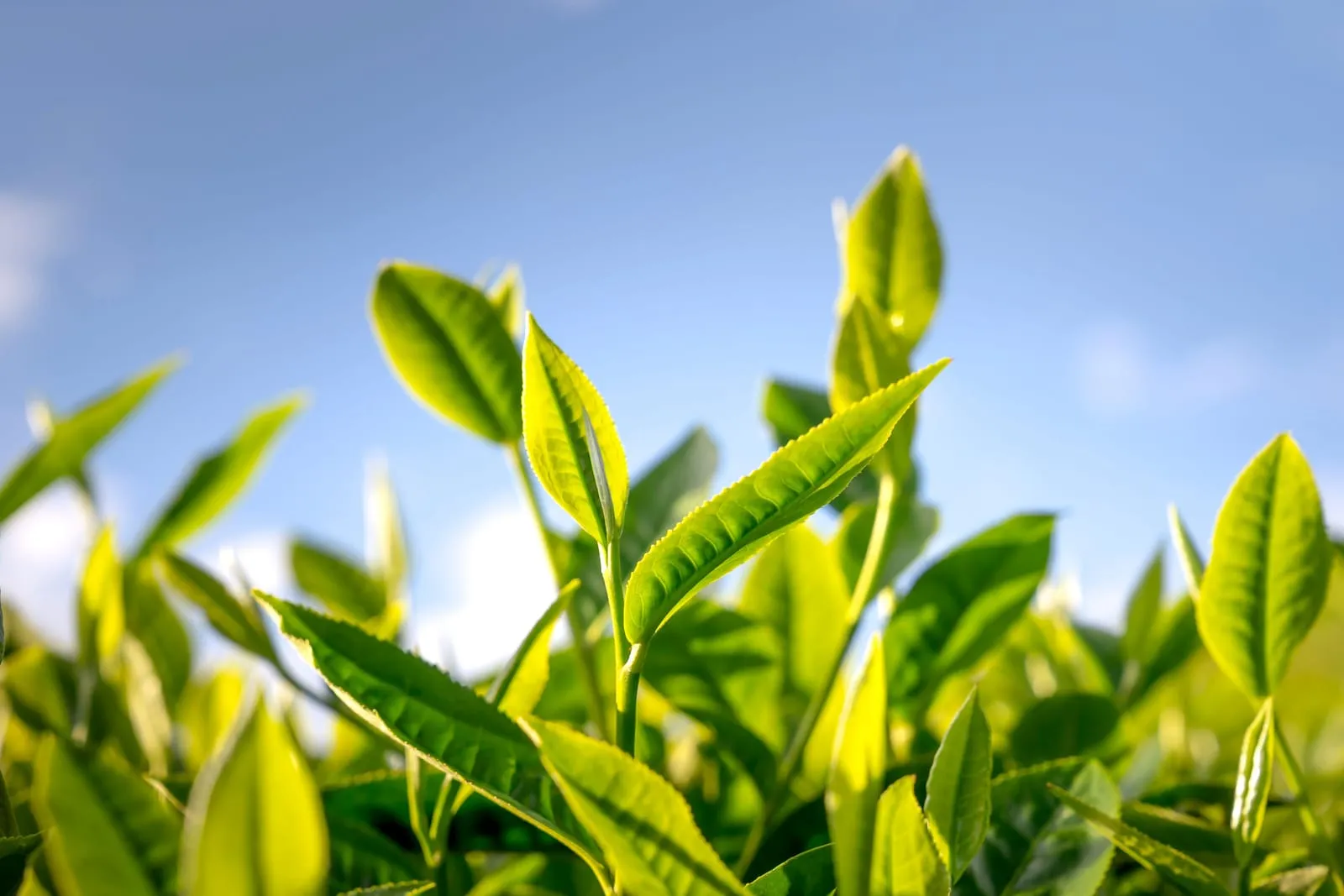
The main water-soluble components of fresh tea leaf (by dry weight) are roughly[1][3]:
| Component | Amount (approx.) | Taste / role |
|---|---|---|
| Polyphenols | 18–36% | Astringent, bitter; core antioxidants; higher in large-leaf cultivars, summer leaf, strong sun |
| — of which catechins | ~70–80% of polyphenols | Main source of astringency and contraction |
| Caffeine | 2–5% | Bitter, stimulating; with trace theobromine and theophylline |
| Theanine | ~1–4% | Umami and sweet, calming, softening bitterness |
| Free amino acids (total) | ~1–5.5% | Freshness and sweetness |
| Soluble sugars | ~2–6% | Sweetness and body; moderates bitterness |
| Pectin, organic acids | small amounts | Mouthfeel thickness and acidic background |
| Aroma compounds & glycosidic precursors | trace | Source of aroma (see oolong zuoqing) |
Flavour is a tug-of-war: polyphenols and caffeine pull toward “bold and astringent,” amino acids and soluble sugars toward “fresh and gentle.” Green tea has the most catechins, so it is brisk yet bitter-astringent; in black tea catechins oxidise into theaflavins and thearubigins, lowering astringency and raising body[3][4].
2. Where bitterness and astringency come from: catechins and caffeine together
The main polyphenols in tea are catechins, accounting for about 70–80% of total polyphenols. Catechins fall into two structural groups[1]:
- Galloylated catechins: EGCG (epigallocatechin gallate) and ECG (epicatechin gallate). Strongly bitter and astringent, with marked drying sensation.
- Non-galloylated catechins: EGC (epigallocatechin), EC (epicatechin) and C (catechin). Less bitter and astringent.
The chemical basis of astringency is that catechins bind to salivary proteins, reducing lubrication and creating a tightening sensation in the mucosa. Galloylated catechins bind proteins more strongly because of their galloyl group, so they feel more astringent[1][5]. Bitterness comes mainly from caffeine, but studies show that caffeine and catechins together produce a clear synergistic increase in bitterness and astringency — the same caffeine concentration tastes more bitter in a catechin-rich liquor[5].
This is why large-leaf cultivars, which are high in catechins, make bold black tea, while small-leaf cultivars suit fresh, fragrant green tea: the polyphenol “base colour” of the raw material sets the ceiling for bitterness and astringency.
3. Where freshness comes from: theanine and umami
Theanine (L-theanine) is a non-protein amino acid characteristic of tea, making up about 1–4% of dry leaf weight, and is the core contributor of umami in tea. Its umami comes from interaction with the T1R1/T1R3 umami receptors on the tongue, similar to how monosodium glutamate is perceived as savoury[6].
Theanine is synthesised from glutamic acid and accumulates mainly in young shoots and roots. It has two key roles:
- Direct umami: high-quality green tea is often described as “fresh as chicken broth” — this is usually high theanine.
- Bitterness softening: theanine can form complexes with caffeine and catechins, reducing their harsh impact and making the liquor feel harmonious[1][6].
Besides theanine, fresh leaf contains glutamic acid, aspartic acid and other free amino acids that together build the fresh-sweet base. Total free amino-acid content is closely tied to the plant’s nitrogen metabolism, shading conditions and plucking tenderness.
4. Aroma potential: glycosidically bound aroma precursors
Tea aroma is not only from free aromatic molecules. Fresh leaves store many aroma compounds as glycosidically bound volatiles (GBVs) — aromatic molecules linked to sugars, themselves almost odourless. During processing, cell damage or heat triggers β-glucosidases and related enzymes to hydrolyse these precursors, releasing linalool, geraniol, leaf alcohol, benzyl alcohol and other volatiles. This is how green tea gets its fresh note, oolong its floral-fruity note, and black tea its sweet floral note[1][7].
Different cultivars store very different aroma-precursor profiles: Zhu Ye cultivar is rich in geraniol and linalool precursors, laying the foundation for Keemun’s rose-honey aroma; Tieguanyin, Shui Xian and other oolong cultivars accumulate more terpenes, jasmone and indole precursors, which is why zuoqing produces such rich floral notes. In other words: the richer and more diverse the aroma precursors in the fresh leaf, the more aromatic material processing has to work with.
5. The molecular mechanism of shading
Shading the plant before harvest does something interesting: with less light, the leaf’s conversion of amino acids into polyphenols is suppressed, so theanine and other amino acids rise while astringent polyphenols fall[8].
Shading Photobiology: L-Theanine vs. Catechin Conversion
Switch shading stages or drag the 0–20 day slider to see how blocking sunlight suppresses theanine-to-catechin conversion and boosts chlorophyll and umami.
About this diagram & its limits
Japanese tea steaming and shading dual-axis illustration · Illustrates light/deep steaming and 0–20 days shading effects on chlorophyll, L-theanine accumulation, and flavor radar; exact levels depend on cultivar and flush.
Craft Parameters & Water Temp
Open-sunlight needle cords, bright yellow-green liquor, brisk and lively.
Open sunlight encourages catechin synthesis from theanine, delivering a brisk vegetal finish.
Relative Biochemical Contents
From a metabolic-pathway perspective, strong light promotes carbon metabolism and active synthesis of phenolics such as catechins; weaker light lets nitrogen metabolism dominate, enhancing the conversion of glutamate into theanine. Japan’s gyokuro and matcha use shade cultivation (kabuse or ooishita), covering the shoots for 2–4 weeks before picking to raise theanine and lower catechins, producing intense umami and the characteristic seaweed-like “covered” flavour[9].
Shading also changes aroma precursors: under low light, precursors of dimethyl sulfide (DMS) and other sulphur-containing aroma compounds accumulate, which is one source of the seaweed note in steamed green tea and gyokuro.
6. How season, tenderness and cultivar affect composition
Fresh-leaf chemistry is not fixed; it shifts dynamically with season, tenderness, cultivar and environment[3][10]:
- Season: spring tea grows in cooler temperatures and moderate light, accumulating more amino acids while polyphenol synthesis is relatively slow, so the polyphenol/amino-acid ratio is low and the taste is fresh. Summer tea faces high temperatures and strong light, increasing polyphenols and caffeine while the amino-acid proportion falls, so the liquor tends strong and astringent.
- Tenderness: tender buds are rich in amino acids and caffeine but relatively low in polyphenols, giving a fresh, delicate cup. Mature leaves have more crude fibre and polyphenols, lower amino-acid proportion, a stronger and more astringent taste, and higher levels of elements such as fluorine and aluminium.
- Cultivar: large-leaf cultivars (e.g. Yunnan large-leaf) usually have markedly higher catechin content than small-leaf cultivars, and are better suited to bold black tea or pu-erh. Small-leaf cultivars (e.g. Longjing population, Fuding Dabaibai) are relatively rich in amino acids and suit fresh green tea, white tea or oolong.
A population metabolomics study of 136 Chinese tea accessions further confirmed that large-leaf populations are significantly enriched in flavanols (catechins), flavonol glycosides and phenolic acids, while small-leaf populations have an advantage in nitrogenous compounds such as amino acids — providing molecular-scale evidence for the empirical rule that “large-leaf is bold, small-leaf is fresh”[10].
7. Typical effects of season, tenderness and cultivar (summary table)
The table below summarises the direction of effect of the three main variables on fresh-leaf components[1][3][10]. Figures are typical trends, not absolute rules:
| Variable | Polyphenols / catechins | Amino acids / theanine | Caffeine | Flavour direction |
|---|---|---|---|---|
| Spring tea | moderate–low | high | high | Fresh, sweet |
| Summer tea | high | relatively low | high | Strong, astringent |
| Tender bud | lower | high | high | Fresh, delicate |
| Mature leaf | high | low | low | Strong, coarse |
| Large-leaf cultivar | high | medium | medium–high | Bold, big structure |
| Small-leaf cultivar | lower | high | medium | Fresh, fragrant |
| Shaded leaf | lower | higher | slightly higher | Sweet-umami, seaweed |
This table’s value is that it connects “raw-material base” with “process choice”. Large-leaf summer tea forced into a clear green style will often be too bitter and astringent to balance; conversely, small-leaf spring tea made into a heavily oxidised black tea may taste thin. “Suitability for processing” is the question of whether raw-material composition and craft can reinforce each other.
8. Polyphenol / amino-acid ratio: a practical index and its boundaries
The ratio of tea polyphenols to amino acids is called the polyphenol / amino-acid ratio (TP/AA ratio), a classic biochemical index for evaluating fresh-leaf quality and suitability for unfermented green tea[1]:
- Moderate-to-low ratio (approx. 4–8 on dry weight basis): abundant amino acids and balanced polyphenols provide a fresh, umami-rich, and structured liquor — the ideal target for most famous green teas.
- Excessively low ratio (< 3, e.g. extreme albino cultivars): while extremely high in theanine (like early-spring Baiye 1) and chicken-soup-like in umami, severe deficiency in catechins leaves the liquor thin and watery, lacking structural astringency, lingering sweetness (huigan), and infusion stamina.
- Excessively high ratio (> 12–15, e.g. summer crops or large-leaf cultivars): high polyphenols make green tea harshly bitter; however, this is the prime raw material for black tea, oolong, or dark tea, where oxidation/post-fermentation transforms polyphenols into rich oxidation polymers.
Crucial scope boundary: The TP/AA ratio is primarily designed for unfermented fresh leaf evaluation. Once in the realm of semi-oxidized (oolong) or fully/post-oxidized (black, dark) teas, catechins undergo extensive oxidation and polymerization. Evaluation focuses on the ratio of polyphenol oxidation polymers (theaflavins TF / thearubigins TR / theabrownins TB in black tea) and complex volatile aroma systems, rather than fresh-leaf TP/AA.
Shading, tender plucking, and selecting suitable cultivars are agricultural strategies for modulating TP/AA and boosting freshness. To explore the ratio interactively, see “Composition & Flavour · the ratio”.
9. From fresh leaf to cup: how processing rewrites composition
Fresh-leaf composition is only the “raw-material base”; what finally decides the cup is how processing selects and transforms these compounds[1][4]:
- Green-tea fixation: high heat rapidly inactivates polyphenol oxidase (PPO), “pausing” catechins, chlorophyll and amino acids in their fresh-leaf state and preserving briskness.
- White-tea withering: no rolling and no fixation; long, slow water loss keeps PPO at low activity, catechins oxidise only slightly, proteins hydrolyse to raise amino acids, creating a lightly oxidised, sweet style.
- Black-tea oxidation: rolling breaks cells and lets PPO meet catechins, oxidising them into golden theaflavins and reddish-brown thearubigins, lowering bitterness and raising body.
- Oolong zuoqing: repeated shaking and resting bruises the leaf edges for localised oxidation, retaining some catechins while developing floral-fruity volatiles, giving “green leaf with red edge” and complex aroma.
- Dark-tea wodui: microbial enzymes and moist heat deeply transform polyphenols into theabrownins, soluble sugars and other products, producing a mellow, smooth aged taste.
In other words: fixation “freezes” the leaf, oxidation “colours” it, and wodui “reshapes” it. Understanding fresh-leaf composition is the prerequisite for understanding why different crafts lead to such different flavours.
10. Common misconceptions
- “The lower the TP/AA ratio, the better the tea.” Incorrect. If TP/AA is too low (as in extreme albino cultivars), the liquor lacks polyphenol structure and finish, tasting thin and flat; additionally, this metric applies primarily to green tea, not oolong or black tea.
- “Higher polyphenols are always better.” Polyphenols are antioxidants and a source of bitterness; too high makes the liquor harsh. Quality lies in the harmony of polyphenols with amino acids and sugars.
- “Higher amino acids always mean fresher.” Amino acids do add freshness, but if polyphenols are also high, bitterness will mask the umami; the polyphenol/amino-acid ratio tells more.
- “Spring tea is always better than summer tea.” For green and white teas that prize freshness, spring is usually preferable; but for black tea or some dark teas that need a bold backbone, summer leaf can also be useful.
- “Good tea is never bitter or astringent.” Moderate bitterness and astringency are part of the liquor’s structure; none at all would feel thin. Quality is about whether they are harmonious and resolve quickly into sweet finish.
- “Aroma comes entirely from later processing.” Processing is crucial for releasing and transforming aroma, but the fresh leaf’s aroma-precursor profile sets the “raw-material library”; you cannot make something from nothing.
See also
- The Botany of the Tea Plant — the plant this leaf grows on
- Tea Cultivars & Famous Varieties — how cultivar sets the compositional base
- The Flavour Wheel — how composition finally becomes “taste”
- Composition & Flavour · the ratio — dial the ratio and watch flavour change
References
- R-029 — 宛晓春 主编 (2003).《茶叶生物化学》(第3版). 中国农业出版社. ISBN: 978-7109066274.
- R-030 — 陈宗懋 主编 (2000).《中国茶叶大辞典》. 中国轻工业出版社. ISBN: 978-7501925094.
- R-032 — Chen, G.-H., et al. (2009). Comparison of major chemical components in different kinds of tea. Journal of Agricultural and Food Chemistry, 57(15), 7325–7330.
- R-033 — Wang, K., et al. (2010). Comparison of catechins and amino acids in white, green, oolong, black, and pu-erh teas. Food Chemistry, 121(2), 338–344.
- R-253 — Xu, Y.-Q., et al. (2018). Quantitative analyses of the bitterness and astringency of catechins from green tea. Food Chemistry, 258, 16–24. https://doi.org/10.1016/j.foodchem.2018.03.042
- R-254 — Kaneko, S., Kumazawa, K., Masuda, H., Henze, A., & Hofmann, T. (2006). Molecular and sensory studies on the umami taste of Japanese green tea. Journal of Agricultural and Food Chemistry, 54(7), 2688–2694. https://doi.org/10.1021/jf0525232
- R-235 — Ho, C.-T., Zheng, X., & Li, S. (2015). Tea aroma formation. Food Science and Human Wellness, 4(1), 9–27. https://doi.org/10.1016/j.fshw.2015.04.001
- R-152 — Tai, Y., Ling, C., Wang, H., et al. (2019). Comparative Transcriptomic Analysis Reveals Regulatory Mechanisms of Theanine Synthesis in Tea (Camellia sinensis) and Oil Tea (Camellia oleifera) Plants. Journal of Agricultural and Food Chemistry, 67(36), 10235–10244. https://doi.org/10.1021/acs.jafc.9b02295
- R-043 — 守屋毅.《お茶の道》. 1983.
- R-057 — Yu, X., et al. (2020). Metabolite signatures of diverse Camellia sinensis tea populations. Nature Communications, 11, 5586. https://www.nature.com/articles/s41467-020-19441-1
Article Knowledge Network
Explore the connections between the teas, processes and flavours in this article.