
Start with the essentials
Everyday green, black and oolong teas usually come from the buds and leaves of the tea plant. This evergreen woody plant is often pruned into low garden bushes; leaves, branches, flowers and fruits reveal different botanical features.
The article connects visible plant parts and leaf anatomy with large- and small-leaf types, growing conditions and harvesting seasons. Understanding the plant helps separate a plucking description, a plant type and a finished tea category.
Three key points
- Plant and category differOne cultivar can serve different methods; key processing changes distinguish tea categories.
- Plant parts describe materialBuds, young shoots and more mature leaves suit different products.
- Growing conditions leave differencesCultivar, season, light and management influence leaves; appearance supplies only part of the explanation.
Connect it with everyday tea
Spread infused leaves on a pale plate and identify buds, leaves and stems. Compare them with plucking and cultivar information. These processed plant parts reveal material choices, but leaf size alone cannot establish tree age or quality.
Classification and name
The tea plant belongs to the family Theaceae, genus Camellia, with the botanical name Camellia sinensis (L.) Kuntze. The epithet sinensis means “of China”, pointing straight to its homeland; it was long placed in a genus of its own (Thea sinensis) before taxonomic revision merged it into Camellia, making it a close relative of the ornamental camellia[2].
Within the genus, the tea group (section Thea) also includes close relatives such as dali tea (C. taliensis) and C. tachangensis from Yunnan. They resemble tea or can hybridise with it and have seen local use, but their taxonomic status (separate species or part of C. sinensis) is still debated; for now they are treated mainly as a wild gene pool for tea breeding rather than mainstream crop plants[2][3]. Being evergreen, the tea plant carries leaves year-round — the basis for multiple harvests.
Origin and domestication
The mainstream academic view places the origin of the tea plant in southwest China — centred on Yunnan and extending into parts of Sichuan and Guizhou. This region holds the richest tea germplasm on earth: from wild tea trees in primary forest to cultivated ancient gardens hundreds to over a thousand years old, forming a complete chain from wild to domesticated[2][4]. The ancient cultivated gardens of Pu’er, Lincang and Xishuangbanna, maintained for generations by seed-grown populations, are themselves living material for studying domestication[2]. Alternative views — an Assam origin, or multiple origins — have been proposed and remain unsettled[5].
Genomics has added new evidence. In 2018 a Chinese team sequenced the genome of the China-type cultivar “Shuchazao”: about 3.1 Gb with roughly 34,000 predicted protein-coding genes[6]. The study dated the divergence of the two varieties — var. sinensis (CSS) and var. assamica (CSA) — to about 0.38–1.54 million years ago, long before any human cultivation. The differences between the varieties are thus mainly a product of natural evolution; a few thousand years of cultivation merely sculpted on top of them[6].
The same study found that tea underwent two ancient rounds of whole-genome duplication (about 30–40 and 90–100 million years ago), and among the gene families expanded as a result are the key genes for catechins, theanine and caffeine — much of why tea tastes the way it does is written into this genome[6].
A 2020 population study went further, analysing the transcriptomes and metabolomes of 136 Chinese tea accessions and resolving them into five major clades, each with signature metabolite patterns: Assam-type (CSA) accessions were markedly enriched in flavanols (i.e. catechins), flavonol glycosides and phenolic acids, in clear contrast to the China-type clades — population-scale molecular evidence for the traditional claim that the Assam type is high in polyphenols. Selection signals detected between populations also suggest the clades experienced different selective pressures during domestication and dispersal[5]. The exact timing and routes of domestication are still under study and are best treated with caution.
Morphology
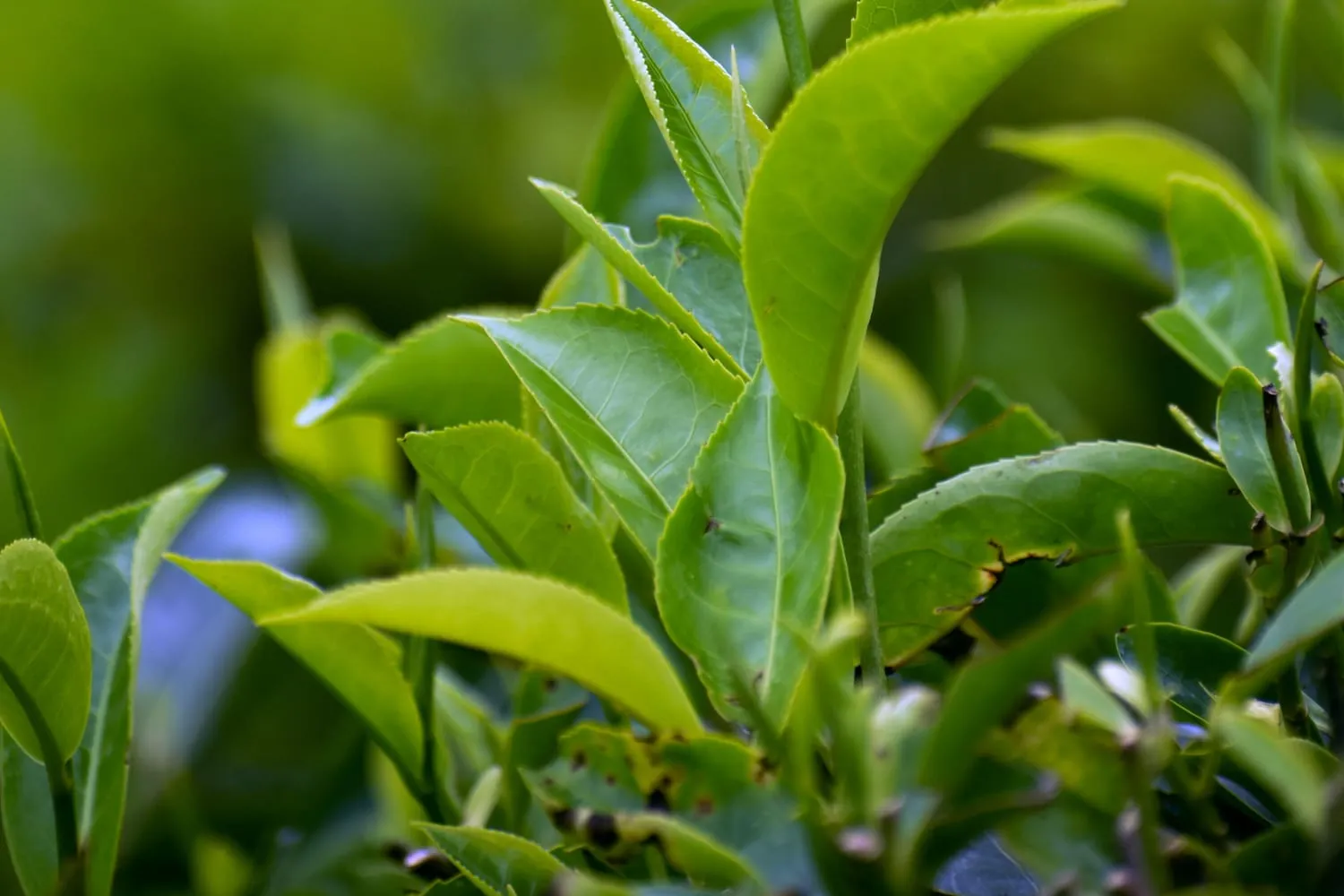
A wild tea plant can become a tree over ten metres tall (Yunnan still has ancient trees centuries to over a thousand years old)[2]; in gardens it is repeatedly pruned into a 1–2 m bush, both for easy plucking and to push new shoots.
- Leaves: alternate, leathery and glossy, with serrated margins. A diagnostic feature is the looped (closed) venation — side veins curve up to join the vein above instead of reaching the margin[3]. Leaf size spans a huge range; Chinese cultivation texts grade mature leaves roughly as small (<20 cm²), medium (20–40 cm²), large (40–60 cm²) and extra-large (>60 cm²)[4] — a quantitative expression of the variety difference below.
- Trichomes: young buds and leaves have fine silvery hairs (trichomes) underneath — the “white down” tied to the downy aroma and look of teas like Silver Needle[3].
- Flowers and fruit: in autumn–winter it bears fragrant white flowers with yellow stamens, about 2–4 cm across, solitary or in pairs; the fruit is a capsule with 1–3 oil-rich seeds[3].
- Shoot colour: young shoots are usually light green; some cultivars bear purple-red shoots (“purple buds”), linked to extra anthocyanin accumulation[1].
Leaf Mesophyll Anatomy: Palisade vs. Spongy Parenchyma
Compare the thick cuticle and two-layer palisade tissue of small-leaf cultivars with the open spongy parenchyma and large vacuoles of large-leaf cultivars.
About this diagram & its limits
Tea plant China type vs. Assam type botanical comparison illustration · Illustrates morphological, anatomical (palisade/spongy ratio), and biochemical (polyphenol-to-amino acid ratio) distinctions between var. sinensis and var. assamica.
China Type (Camellia sinensis var. sinensis)
Camellia sinensis var. sinensis
6–9 pairs of lateral veins, fine acute teeth, blunt apex
Jiangnan (Longjing, Biluochun), Fujian (Tieguanyin, Silver Needle), Japan (Sencha)
Assam Type (Camellia sinensis var. assamica)
Camellia sinensis var. assamica
10–16 pairs of lateral veins, bullate leaf surface, sparse teeth
Yunnan (Pu-erh, Dianhong), Assam (India), Kenya, Sri Lanka
The two varieties
The comparison above shows the core differences. Here are the typical ranges for key traits (they shift with cultivar, season, environment and measurement method, and are for orientation only)[1][4][5]:
Tea Plant Botanical Workbench: China Type vs. Assam Type
Compare China small-leaf type (shrub habit, thick palisade tissue, low polyphenol-to-amino-acid ratio, best for green/oolong/white) with Assam large-leaf type (arborescent tree, open spongy tissue, massive catechins, best for black and pu-erh).
About this diagram & its limits
Tea plant China type vs. Assam type botanical comparison illustration · Illustrates morphological, anatomical (palisade/spongy ratio), and biochemical (polyphenol-to-amino acid ratio) distinctions between var. sinensis and var. assamica.
China Type (Camellia sinensis var. sinensis)
Camellia sinensis var. sinensis
6–9 pairs of lateral veins, fine acute teeth, blunt apex
Jiangnan (Longjing, Biluochun), Fujian (Tieguanyin, Silver Needle), Japan (Sencha)
Assam Type (Camellia sinensis var. assamica)
Camellia sinensis var. assamica
10–16 pairs of lateral veins, bullate leaf surface, sparse teeth
Yunnan (Pu-erh, Dianhong), Assam (India), Kenya, Sri Lanka
| Trait | China type var. sinensis | Assam type var. assamica |
|---|---|---|
| Habit | shrub to small tree | small tree to tree |
| Leaf size | mostly <7 cm long, ~10–25 cm² in area | often >10 cm long, ~40–70 cm² in area |
| Leaf texture | leathery, rather stiff | thinner, soft |
| Tea polyphenols (dry wt.) | ~18–25% | ~25–33%, higher in some cultivars |
| Catechins (dry wt.) | ~10–15% | ~15–22% (catechins are ~60–80% of polyphenols) |
| Caffeine (dry wt.) | ~2–4% | ~2–4%, broadly similar |
| Cold hardiness | strong; tolerates short spells near -10 °C | weak; frost damage possible around 0 °C |
| Suited to | green, white, oolong | black tea, pu-erh (sun-dried) |
The key point: variety is the “base coat” of the raw material — it genetically sets leaf size, compounds (especially polyphenols) and hardiness, on top of which terroir and craft build the finished tea. Population metabolomics shows that Assam-type clades are indeed significantly richer in polyphenols (especially catechins) than China-type clades at the population level[5]; yet the two varieties hybridise freely, and countless intermediate and bred hybrid types exist, so real production is never either-or[2].
Cytology and genetic diversity
The tea plant has a base chromosome number of x=15, and cultivated tea is mostly diploid, 2n=30; natural triploids and other variants occasionally occur — such plants are highly sterile due to disturbed meiosis and can only be preserved by clonal propagation[4].
More decisive is the tea plant’s self-incompatibility: pollen from the same plant can rarely fertilise its own flowers, so in nature tea is an almost obligate out-crosser[4]. Two consequences follow:
- Every seed is a fresh recombination. Seed-grown “population” stock varies hugely from plant to plant — sprouting time, leaf shape and colour, polyphenol and amino-acid ratios all differ, and quality within one garden is uneven.
- A superior individual’s traits cannot be passed on stably by seed. Even a superb mother plant sees its seed offspring segregate all over again.
This is the logical starting point of modern tea breeding: once an outstanding individual is found, it is fixed by clonal propagation (cuttings) into a genetically uniform “clonal cultivar”. Fuding Da Bai, Longjing 43 and Tieguanyin are each, in essence, one cloned and multiplied individual[4].
Propagation and cultivars
Following the genetics above, the two propagation routes have distinct roles[4]:
- Seed (sexual lines, “population” stock): variable and inconsistent, but genetically diverse — a treasure house for breeders, and a source of the flavour complexity of some traditional teas (such as Wuyi “caicha” gardens and Yunnan’s ancient tea gardens);
- Cuttings (clonal “cultivars”): uniform sprouting and traits, enabling standardised processing and mechanical plucking — the mainstay of modern quality teas, where consistency is paramount.
Propagation by cuttings relies on the tea stem’s ability to form adventitious roots: a semi-lignified short cutting set in a nursery bed roots within weeks, yielding a plant genetically identical to its mother[4]. A single outstanding individual can thus be multiplied into whole gardens. Bred cultivars then go through regional trials and official registration — with suitability for processing, stress resistance, yield and quality as the core criteria — before being released for planting[4].
For representative cultivars, their suitability and how they spread, see Tea Cultivars and an Atlas of Famous Varieties.
Growing conditions
Tea is a classic humid subtropical crop. The typical suitable ranges in cultivation texts (which shift with cultivar and microclimate)[4][5]:
- Temperature: annual mean about 15–25 °C, with growth optimal around 18–25 °C; growth largely stops below about 10 °C. Frost tolerance varies by variety (see the table above).
- Rainfall and humidity: annual rainfall about 1,000–2,000 mm, ideally 1,200–1,800 mm and evenly spread; relative humidity around 75–85% in the growing season. It fears drought — and waterlogging even more.
- Soil: well-drained acidic soil (about pH 4.5–6.5, ideally 4.5–5.5); avoid calcareous soils and heavy, waterlogged ground.
- Light: prefers diffuse light and tolerates some shade — one reason understorey and high-mountain garden teas often taste better[5].
High altitude, cloud and large day–night temperature swings tend to slow growth and let leaves accumulate more compounds, giving better flavour[5].
Common misconceptions
- “The two varieties are two species”: no. They are two varieties of one species, Camellia sinensis; they hybridise freely, and countless intermediates exist in the wild and under cultivation[2].
- “Old-tree tea is wild tea”: old age is not wildness. Yunnan’s ancient gardens are largely cultivated populations propagated from seed over generations; genuinely wild tea resources (including relatives like C. taliensis) mostly never entered commercial tea production[2].
- “The higher the altitude, the better the tea”: altitude only affects quality indirectly, through temperature, cloud and day–night temperature swings, and within a suitable range; too high means slow growth and very low yields — higher is not simply better[5].
See also
- The Flavour Chemistry of the Fresh Leaf — what’s in the leaf and how it shapes taste
- Tea Cultivars and an Atlas of Famous Varieties — how representative cultivars are classified, bred and matched to teas
- The World Tea Map — how terroir and cultivar together shape the leaf
References
- R-029 — 宛晓春 主编 (2003).《茶叶生物化学》(第3版). 中国农业出版社. ISBN: 978-7109066274.
- R-030 — 陈宗懋 主编 (2000).《中国茶叶大辞典》. 中国轻工业出版社. ISBN: 978-7501925094.
- R-042 — 庄晚芳 主编 (1988).《中国茶树栽培学》. 上海科学技术出版社. ISBN: 978-7532304899.
- R-134 — Willson, K. C., & Clifford, M. N. (1992). Tea: Cultivation to Consumption. Chapman & Hall.
- R-251 — Wei, C.-L., et al. (2018). Draft genome sequence of Camellia sinensis var. sinensis provides insights into the evolution of the tea genome and tea quality. PNAS, 115(18), E4151–E4158. https://doi.org/10.1073/pnas.1719622115
- R-057 — Yu, X., et al. (2020). Metabolite signatures of diverse Camellia sinensis tea populations. Nature Communications, 11, 5586. https://www.nature.com/articles/s41467-020-19441-1
Article Knowledge Network
Explore the connections between the teas, processes and flavours in this article.