
Start with the essentials
Two puzzles are common: a “special grade” tea that is not to your taste, and two similar-looking teas several times apart in price. A grade is a quality specification within one product system; a price stacks costs for leaf, origin, processing, channel, packaging and storage. Both are clues, but neither decides what tastes good to you.
This article starts from how the tea will be used, explains what grades cover and what drives price, then shows how to compare samples at home and work out cost per session.
Three key points
- Grades compare within one systemThey reflect tenderness and workmanship, not cross-category rank or personal taste.
- Price stacks several costsLeaf, origin and processing differ in the tea itself; channel, packaging and stories can widen the gap.
- Side-by-side tasting is more reliableBrew similar teas under the same conditions and weigh cost per session.
Do this before you buy
Before your next purchase, note the use and budget, pick samples of two or three similar teas, brew them together with the same leaf, water and time, and record price and impressions before deciding.
Decide who it is for and how it will be drunk
The same budget leads to different choices depending on use:
| Use | Worth prioritising | Less important |
|---|---|---|
| Your daily cup | Consistent taste, several good infusions, reasonable cost per cup, easy to rebuy | Packaging, rarity |
| Learning a category | Small samples of a few representative teas to compare | Buying in bulk |
| A gift | Complete product information, the recipient’s taste and brewing habits | A “top grade” you have never tasted |
| Office or cold brew | Tea bags or broken grades, quick and easy to control | Whole-leaf appearance |
Settle the use first and a “special grade” label or a high price is less likely to decide for you.
What a grade actually tells you
In mainland China many teas have product standards that grade them by sensory factors (dry leaf appearance, liquor colour, aroma, taste and infused leaf) and physicochemical limits. Professional evaluation compares samples of the same kind under fixed vessels, leaf weight, water temperature and time[1].
The Congou black tea standard, for example, sets sensory and physicochemical requirements for each grade[2]; jasmine tea has its own standard and grade system[3]. Three readings follow:
- Grades compare within one system. A “special grade” jasmine tea and a “grade one” Longjing cannot be ranked against each other.
- Grades usually reflect leaf tenderness and evenness of workmanship. Studies of Keemun black tea and Fujian white tea grades do find differences in aroma and taste compounds between grades[4][5].
- A higher grade is not necessarily more to your taste. Tender leaf tends to be fresh and fine; some drinkers prefer the body and stamina of more mature leaf. A grade is a quality specification, not a ranking of personal preference.
Other words are not formal grades: “pre-Qingming” is a harvest time, “first flush” a batch, and “old tree”, “core area” or “master-made” are claims about origin or craft. They can matter, but the seller should be able to back them up. See Reading tea labels.
What a price is made of
A tea’s price can be broken into parts. Each can legitimately raise the price, and each can also be dressed up as a premium:
| Cost | Why it costs more | What to ask |
|---|---|---|
| Leaf tenderness | Buds and bud-and-leaf picking take more labour, and more fresh leaf per gram of dry tea | What was picked? |
| Origin and season | Specific areas and early-spring batches are limited | Are origin and harvest time recorded? |
| Processing and refining | Hand work, repeated roasting and careful sorting add labour and loss | What exactly was done? |
| Channel and brand | Shops, packaging and marketing are part of the price | What does the tea cost without the gift box? |
| Age | Some categories are stored for years, which takes time and space | Is there evidence of age and storage conditions? |
Teas of the same origin and grade can differ widely in price between shops, mostly because of the last three rows. Compare prices per 100 g or per session at least, and check the net weight of gift boxes in particular.
Be cautious when a high price comes with vague claims such as “rare”, “will appreciate” or “collector grade” but no origin, age or storage records. This site does not discuss tea as an investment.
Compare samples side by side
The most reliable way to choose is to brew several teas at once under the same conditions. This borrows the logic of professional evaluation[1] and can be simplified at home:
- Compare like with like, for example three Congou black teas or three jasmine teas.
- Fix the conditions: the same leaf weight (say 3 g), water volume, temperature and time, in matching cups.
- Look at the dry leaf, then the liquor and infused leaf. Check the dry leaf for evenness and colour, the liquor for clarity; smell it hot, warm and cool; finally see whether the infused leaves are whole and even.
- Go several infusions. A good first cup does not prove stamina; taste at least to the third.
- Write down the prices next to each tea and decide at the end whether the difference is worth it.
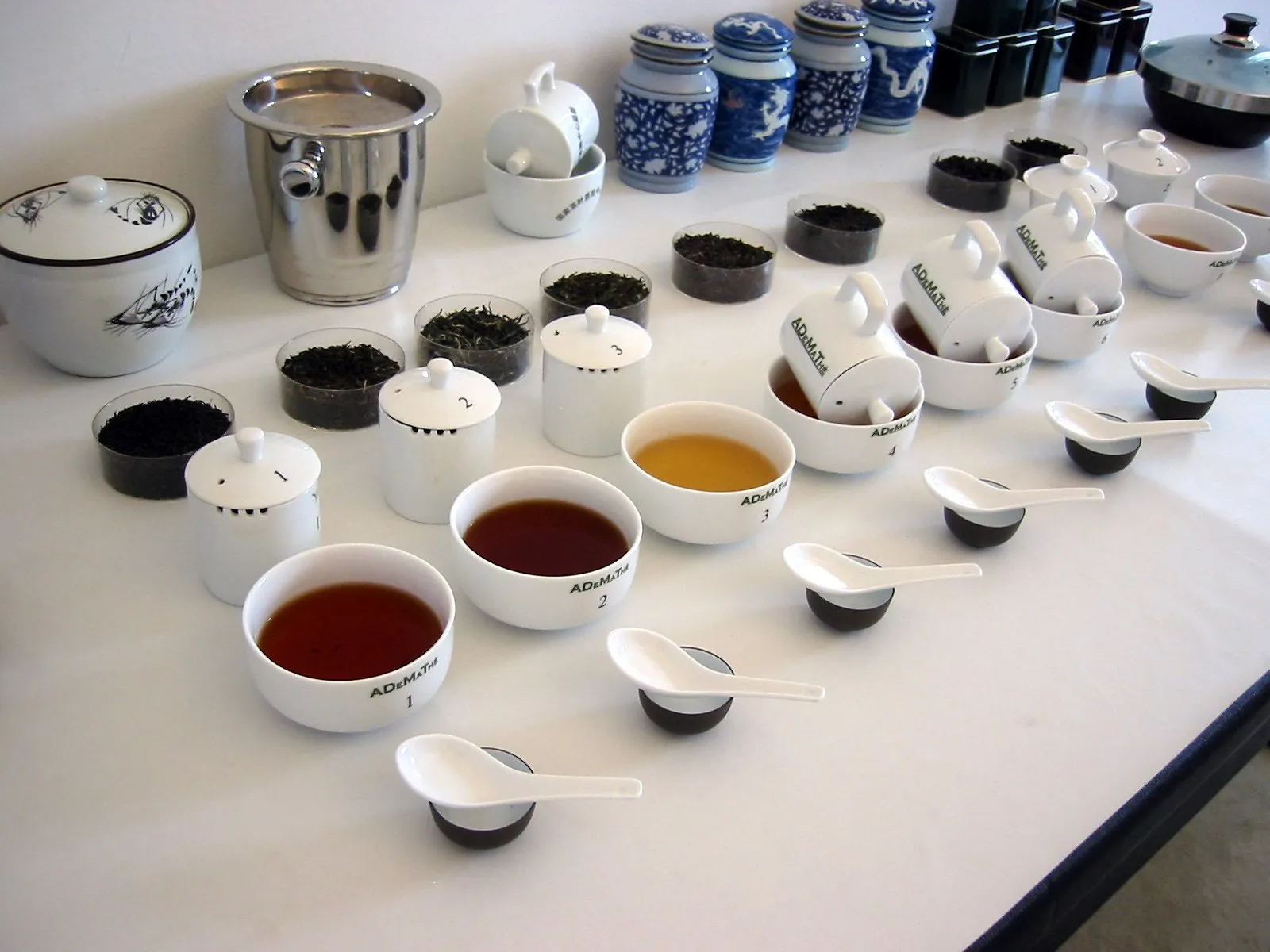
The most common finding is that two teas with very different prices differ less than expected under your own brewing, or that the cheaper one suits you better. That is the point of comparing.
Work out the cost per session
Converting price to cost per session makes everyday choices much clearer. The figures below only illustrate the arithmetic:
A 250 g pack costs 300 yuan, and you use 5 g per session. 250 ÷ 5 = 50 sessions; 300 ÷ 50 = 6 yuan per session. If a session gives five infusions, each cup costs about 1.2 yuan.
A 50 g pack at 150 yuan works out at 15 yuan per session. The difference is in what you spend each day, not just the number on the pack. Count stamina too: a tea that gives more infusions costs less per cup.
Lowering the risk of a bad purchase
- Start small. From a new shop or a new tea, buy a sample or the smallest size first.
- Prefer complete information. Name, producer, dates, net weight, storage conditions and standard make problems traceable.
- Safety depends on standards and channels, not on looks. Pesticide residues have legal limits and need laboratory testing; appearance, aroma and rinsing cannot replace it[6]. Buying through reputable channels and keeping the packaging are the main protections available to most people.
- Be wary of specific health promises. Tea is a drink, not a treatment. See Tea and health.
- Check on arrival. Look for clumping from moisture, mould spots and off odours; do not taste tea with suspected mould.
Buying online and in person
In a shop you can taste and smell the dry leaf, but the water, teaware and brewing differ from home, so the impression may not repeat. Ask for a brew at a standard leaf weight and take a sample home to try your own way.
Online, you cannot see the tea, so look harder at checkable details: are origin, harvest time, batch, net weight and storage specific, and is a small size available? Photos and descriptions show how the seller presents the tea; your own side-by-side tasting is what decides.
Related entries
- Reading tea labels: separate origin, grade, dates and standards from marketing words.
- Sensory evaluation methods: how professional evaluation fixes conditions and scores factors.
- Brewing basics: a steady starting recipe for comparison tastings.
- Storing tea at home: what to do once a pack is opened.
- Jasmine tea and reprocessed teas: reading scenting rounds and grades for floral teas.
References
- R-161 — GB/T 23776-2018.《茶叶感官审评方法》(Methodology for sensory evaluation of tea). National Technical Committee for Tea Standardization (SAC/TC339).
- R-065 — GB/T 13738.2-2017.《红茶 第2部分:工夫红茶》(Black tea—Part 2: Congou black tea). National Technical Committee for Tea Standardization (SAC/TC339).
- R-412 — General Administration of Quality Supervision, Inspection and Quarantine; Standardization Administration of China (2017). Jasmine tea 《茉莉花茶》(GB/T 22292-2017). Issued 2017-11-01, effective 2018-02-01, replacing GB/T 22292-2008.
- R-092 — Su, E., et al. (2022). Aroma effects of key volatile compounds in Keemun black tea at different grades: HS-SPME-GC-MS, sensory evaluation, and chemometrics. Food Chemistry, 373, 131587. https://doi.org/10.1016/j.foodchem.2021.131587
- R-212 — Zong, K., et al. (2026). Chemical Drivers of Flavor Variation Across Cultivars and Grades of Fujian White Tea Revealed by Integrated Volatile and Non-Volatile Metabolomics. Foods, 15(3), 458. https://doi.org/10.3390/foods15030458
- R-054 — GB 2763-2026. National food safety standard: Maximum residue limits for pesticides in food 《食品安全国家标准 食品中农药最大残留限量》. National Health Commission, Ministry of Agriculture and Rural Affairs, State Administration for Market Regulation. Effective 2026-03-01, replacing GB 2763-2021.
Article Knowledge Network
Explore the connections between the teas, processes and flavours in this article.