
Start with the essentials
Huoshan Huangya turns yellow after—not before—thermal enzyme fixation. By tossing tender local shoots in a gentle pan only enough to halt PPO while keeping pliant internal moisture, makers create warm-humid menhuang conditions where chlorophyll converts cleanly to pheophytins and astringent catechins soften.
Using comparative studies of the local Huoshanjinjizhong cultivar, this monograph separates bud yellowing plus gentle basket drying from heavy high-fire roasting used to build crisp-rice pyrazines in coarse large-leaf yellow teas.
Three key points
- Menhuang is controlled moist heat, not microbial spoilageresidual warmth and ventilated humidity convert green pigments and mellow harsh catechins without sourness.
- Raw shoot grade steers drying firetender buds retain higher amino acids and galloylated catechins favoring gentle drying, whereas mature large leaves invite high-fire heterocyclic pyrazines.
- Pan or chamber heat does not equal leaf temperaturetiming shifts dynamically with batch thickness, leaf tenderness, and ambient humidity.
What to notice when tasting
Brew a fresh Huoshan Huangya next to either a baked green tea or a heavily roasted large-leaf yellow tea starting around 80–85 °C, comparing liquor clarity, astringency drop, and sweet cereal vs. toasted notes.
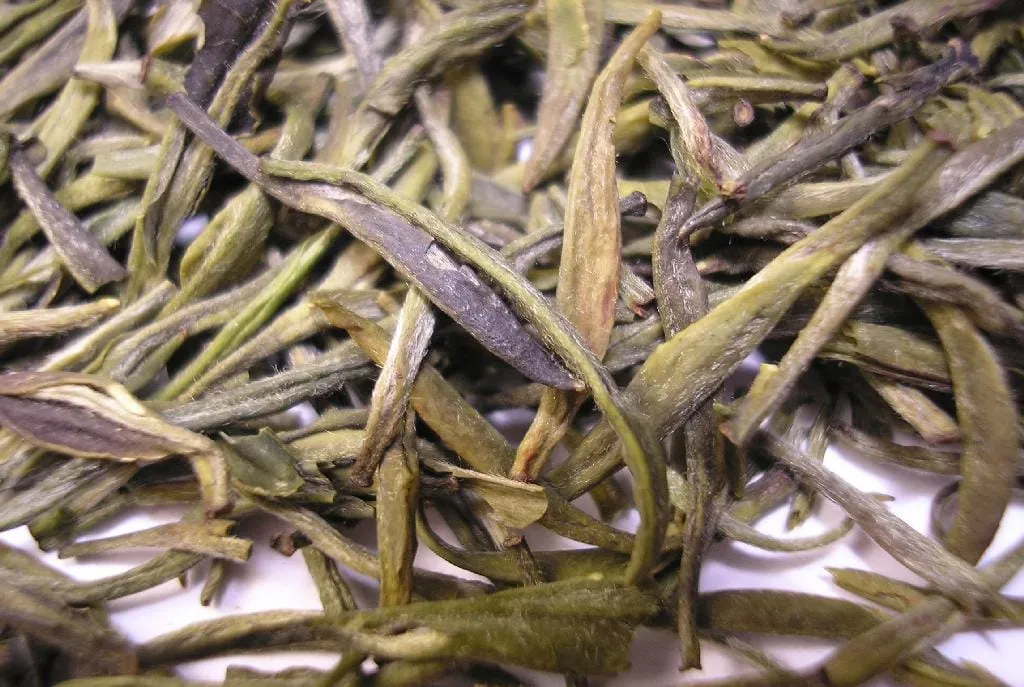
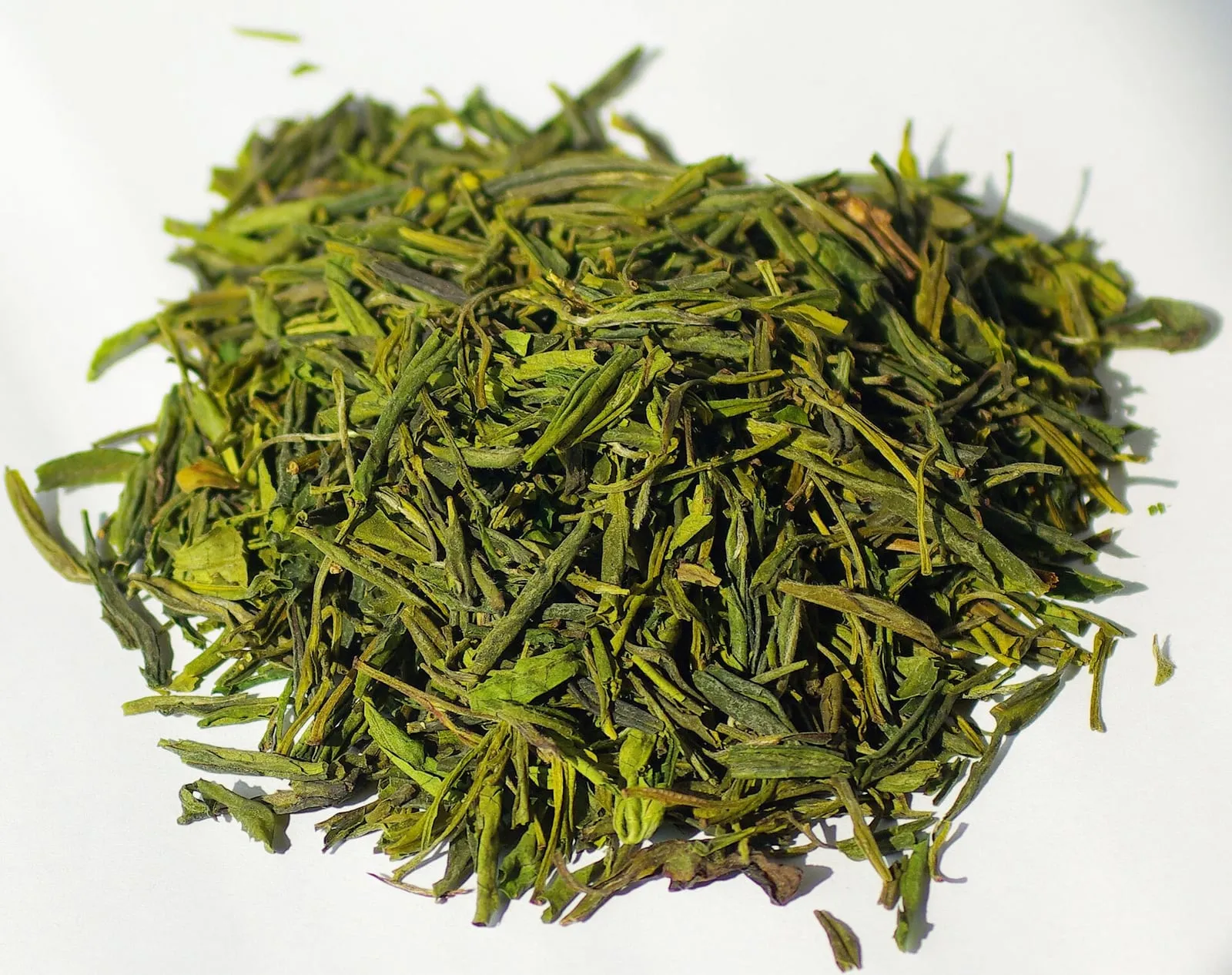
Pick up a handful of finished Huoshan Huangya and look closely before pouring water. Rather than displaying emerald green like spring pan-fired green teas or pure amber gold like heavily yellowed needles, the plump, slightly parted “sparrow-tongue” shoots sit in a luminous yellow-green tone wrapped with fine silver down[2]. In the cup, grassy sharpness steps aside early: the infusion clears to bright chartreuse-yellow with sweet-brothy tenderness and markedly softened astringency. That contrast between green-tea morphology and mellow rounded mouthfeel reflects careful moisture retention during gentle pan fixation, ventilated warm-humid yellowing (menhuang), and restrained basket drying.
1. Taxonomy, Geographical Boundaries & Single-Cultivar Grade Split
1.1 National Classification and Dabie Mountain Origins
Under China’s national yellow tea standard GB/T 21726-2018 Yellow tea, yellow teas are grouped by shoot maturity into yellow bud tea, small-leaf yellow tea, and large-leaf yellow tea—all anchored by thermal enzyme inactivation followed by warm-humid yellowing (menhuang) to transition pigments and soften harsh catechins[1].
Within Huoshan County on the northern slopes of the Dabie Mountains in Anhui Province, one regional production ecosystem uniquely yields all three grades: tender Huoshan Huangya (DB34/T 319-2012 *Product of Geographical Indication—Huoshan Huangya*)[2], tender one-bud-one/two-leaf Huoshan Huangxiaocha, and coarse multi-leaf Huoshan Huangdacha. Crucially, DB34/T 319-2012 specifies geographical boundaries, cultivar baselines, and baseline appearance/physicochemical thresholds for product authentication—it does not scientifically certify Dabie mountain soil minerals as inherently superior to other yellow-tea origins[2].
1.2 One Local Cultivar, Three Divergent Processing Futures
A widespread misconception assumes that delicately sweet Huoshan Huangya and “crispy-rice” large-leaf Huoshan yellow tea come from wholly unrelated tea plants. Both traditionally draw heavily on the local population cultivar Huoshanjinjizhong (Camellia sinensis var. sinensis). In a 2024 comparative metabolomics investigation comparing bud yellow tea (BYT), small-leaf yellow tea (SYT), and large-leaf yellow tea (LYT) processed from differently matured shoots of Huoshanjinjizhong (Qin et al., 2024)[3]:
- Researchers identified 64 volatile compounds (including 11 key odorants, where heterocyclic compounds varied the most dramatically across tea grades) alongside 1,781 non-volatile metabolites (with 43 key differential taste-associated markers)[3];
- Bud yellow tea (BYT) accumulated markedly higher levels of galloylated catechins, purine alkaloids, and free amino acids than SYT and LYT—establishing a rich, savory-sweet broth baseline that responds cleanly to light yellowing and gentle-to-moderate drying[3];
- As shoots mature into coarse large-leaf stems (LYT), free amino-acid reserves decline relative to glycosidic/fibrous tissue, pushing traditional makers toward deeper repeated piling and higher-fire roasting to strip rawness and synthesize nutty, cereal-like pyrazines.
2. Moisture-Retaining Fixation, Ventilated Menhuang & Process Observation
Traditional Huoshan Huangya follows an integrated chain: light fresh-leaf spreading → moisture-retaining gentle fixation → cool/gentle shaping → warm-humid yellowing (menhuang) → staged basket drying with intermediate conditioning. Compared with deeply yellowed large-leaf batches, Huangya restraint aims for a bright yellow-green balance without murky over-yellowing or souring[2][9].
2.1 Pan Temperature Is Not Leaf Temperature—Why Ventilation Saves the Heap
Two assumptions commonly mislead newcomers: treating pan surface settings as true internal leaf temperature, and assuming menhuang means sealing wet tea airtight until it spoils. In tea processing physics, heated pan contact supplies surface energy while vaporizing leaf water absorbs latent heat; true leaf temperature, residual moisture content, and batch depth determine how cleanly PPO/POD are suppressed. Once enzymatic browning is arrested, residual moisture and gentle warmth allow weak organic acids to drive non-enzymatic chlorophyll pheophytinization (green → olive/amber-yellow tones), catechin thermal isomerization (reducing sharp astringency), and gentle sugar–amino condensation—rather than anaerobic bacterial souring or mold growth[4][9].
Gentle Fixation & Menhuang: Turning Green Shoots Warm Yellow
Stage 01: moisture-preserving fixation; Stage 02: humid yellowing.
Halt PPO quickly while keeping residual soft moisture
- Curved iron pan allows quick tossing and sliding
- Controlled moderate pan heat (not burnt leaf temp)
- Young shoots retain suppleness for yellowing
- Grassy water vapor exits before cover wrapping
Unlike dry green tea pan-firing, yellowing needs enough retained moisture and heat.
Conditions, chemistry & standards
- Heat regime
- Moderate pan heat descending through tossing (pan != leaf temp)
- Duration
- Brief shake-and-cover fixation preserving soft moisture
- Moisture
- ~75–78% fresh → pliable moist leaf after fixation
- Leaf state
- Becomes supple and olive-green without scorched margins
Harvested from local Huoshanjinjizhong bud-and-one-leaf shoots, fixation halts browning enzymes while preserving residual heat and moisture required for the gentle yellowing reaction.
Small-pan hand tossing to denature PPO without over-drying
Standards: GB/T 21726-2018 (Yellow Tea) and Anhui GI standard DB34/T 319-2012 (Product of Geographical Indication — Huoshan Huangya).
Equipment/chamber temperature is not leaf-core temperature; workshop yellowing and drying schedules shift continuously with bud tenderness and local weather.
If pan-tossing dries shoots too far, water activity drops too low for smooth yellowing and leaves lock green; conversely, under-fixed overly wet piles kept unventilated overheat, re-trigger residual browning, or turn sour and blackened. Watching heap aroma, moisture bead condensation, and periodic aeration turns is far more reliable than adhering to a rigid wall-clock duration.
2.2 Experimental Insights into Yellowing Humidity, Temperature, and Aeration
Controlled studies across yellow-tea systems illustrate how tightly yellowing responds to moisture and heat—always bearing experimental boundaries in mind:
- Temperature–Humidity Regimes (Chen et al., 2024): Testing
40 °C / 90% RH,50 °C / 50% RH, and30 °C / 70% RHyellowing environments revealed 75 volatile compounds with 42 showing statistically significant differences, proving that thermal–moisture balance distinctly shifts green fresh notes versus warm sweet aromatics[5]. - Sealed Chamber & Ventilation Optimization (Wu et al., 2025): Studying Zhejiang Pingyang Huangtang leaf blanks, researchers found optimal sensory ratings within their experimental design at 60 °C, 70% RH, 10 h total duration with 2 intermittent ventilations, tracking pronounced chlorophyll degradation alongside declines in galloylated catechins and the polyphenol-to-amino-acid (TP/AA) ratio that soften astringency[6]. Treated strictly within its cultivar and Pingyang chamber scope, that study illustrates why controlled humidity plus timely venting lowers harshness—rather than prescribing an identical numeric recipe for delicate Huoshan buds.
3. Drying & Roasting Divergence: Tender Buds vs. High-Fire Large Leaves
After yellowing, drying splits the Huoshan family decisively: Huoshan Huangya proceeds through gentle basket drying or mild warm-air finishing to preserve spring amino brightness, whereas mature-leaf LYT shifts toward progressive high-fire roasting[7][8].
Gentle Drying vs. High-Fire Roasting & Cup Assessment
Stage 03: gentle bud baking; Stage 04: reading liquor hue & clarity.
Gentle multi-stage basket baking protects delicate bud amino acids
- Waisted bamboo roasting basket lifts leaf above bed
- Tender sparrow-tongue buds spread thin in center tray
- Soft ember glow gives mild sweetness without scorching
- Diverges from high-fire Large-Leaf Yellow Tea pyrazines
Bud yellow tea keeps fresh sweetness with gentle baking rather than intense old-fire char.
Conditions, chemistry & standards
- Heat regime
- Low-to-medium staged basket drying (lighter than coarse LYT roasting)
- Duration
- Alternating initial bake, cooling, and final finishing dry
- Moisture
- Dried below ~5–6% for storage stability
- Leaf state
- Straight, sparrow-tongue olive-yellow buds with visible down
Same-cultivar studies confirm bud yellow tea retains higher amino acids and galloylated catechins than coarse large-leaf yellow tea, calling for gentle drying rather than intense high-fire roasting.
Staged low-heat basket drying preserves amino-acid freshness rather than deep burnt pyrazines
Standards: GB/T 21726-2018 (Yellow Tea) and Anhui GI standard DB34/T 319-2012 (Product of Geographical Indication — Huoshan Huangya).
Equipment/chamber temperature is not leaf-core temperature; workshop yellowing and drying schedules shift continuously with bud tenderness and local weather.
Two mechanistic studies of large-leaf yellow tea roasting explain why high-fire “crispy-rice” protocols should not be projected onto tender Huoshan Huangya:
- Heterocyclic Accumulation Under High Fire: Comparing five roasting intensities in large-leaf yellow tea, Li et al. (2023) measured total heterocyclic volatiles climbing from
6.47 ± 0.27up to1065.00 ± 5.58 µg/g, accompanied by N-ethyl-2-pyrrolidinone-substituted flavanols (EPSFs) accumulation, lower bitterness/astringency, and intensifying crispy-rice and burnt profiles[8]. Complementary sensory-recombination work comparing small, medium, and old fire (Guo et al., 2021) likewise showed old-fire roasting building clean crispy-rice aroma without burnt off-notes, featuring high odor-activity 2,3-diethyl-5-methylpyrazine (OAV > 1,600) and trans-β-ionone (OAV > 39)[7]. - Why Huoshan Huangya Stops Short of Heavy Fire: Because Huoshanjinjizhong single-bud batches already hold abundant free amino acids and refined soluble catechins (as seen in BYT vs. LYT contrasts)[3], blasting them with high pyrazine-generating heat consumes amino sweetness and coats delicate floral-bean clarity in roasty toast. Mild-to-medium staged drying simply locks moisture down cleanly for stability while retaining crisp-sweet spring lift and light warm-grain nuance.
| Process & Analytical Dimension | Huoshan Huangya (Bud Yellow Tea) | Large-Leaf Yellow Tea (e.g., Huoshan Huangdacha) | Observational & Evidence Boundary |
|---|---|---|---|
| Shoot Maturity Input | Early-spring tender bud + opening first leaf (amino-rich) | Mature 4–5th leaves + woody stems | Both share Huoshanjinjizhong genetics; shoot composition steers thermal tolerance[3] |
| Yellowing Intensity | Mild warm piling/wrapping post light fixation with frequent aeration | Prolonged high-moisture piling/re-stacking after primary drying | Both rely on non-enzymatic conversion, paced to leaf thickness and moisture[4][6][9] |
| Thermal Drying Target | Gentle staged basket drying avoiding scorched trichomes | Heavy high-fire roasting to drive Maillard & pyrolysis reactions | High fire builds pyrazines (~1065 µg/g max in LYT trials) that overwhelm tender buds[3][7][8] |
| Resulting Cup Profile | Bright yellow-green liquor, low astringency, sweet broth, gentle bean/grain warmth | Deep amber-yellow infusion, thick smooth mouthfeel, roasted crispy-rice aroma | Sensory impressions arise from integrated volatile and taste matrix synergy[3][8] |
4. Integrated Biochemical Trajectory & Sensory Profile
Linking moisture-retaining fixation, ventilated yellowing, and gentle drying clarifies every shift seen and tasted in the cup:
Huoshan Huangya
Yellow · Gentle Fixation & Bud Yellowing5. Adjustable Brewing Starting Points & Side-by-Side Tasting
Thin, tender Huoshan Huangya buds extract quickly and lack thick cuticles or heavy roast armor. Treat these settings strictly as flexible starting dials, adjusting to leaf freshness and personal preference:
- Tall Glass or White Porcelain Gaiwan (Everyday Starting Point):
- Measure about
3 gtea into a150–180 mLtall glass or110 mLporcelain gaiwan; - Begin near
80–85 °C(water rested briefly in a sharing pitcher after boiling); in a gaiwan, start around10–15 sand extend subsequent steeps by5–10 s. - If aroma feels subdued or broth lacks sweetness, raise water toward
88–90 °Cwith slightly faster pours rather than treating 85 °C as an unbreakable ceiling.
- Measure about
- Three-Way Comparative Tasting Exercise:
- Brew a spring Huoshan Huangya side-by-side against a fresh pan/basket-dried spring green tea (and optionally a high-fire large-leaf yellow tea) at matching water temperature and
1:50–1:40ratios for 1 minute; - Smell the wet cup lid for reduced raw grassy sharpness relative to unyellowed green tea, compare tongue-coating softness as the liquor cools a few degrees, and contrast clean sweet grain tenderness against the roasted cereal pyrazines of high-fire large-leaf styles.
- Brew a spring Huoshan Huangya side-by-side against a fresh pan/basket-dried spring green tea (and optionally a high-fire large-leaf yellow tea) at matching water temperature and
6. Common Myths & Scientific Clarifications
Myth 1: “Menhuang yellowing means rotting or fermenting tea with bacteria and molds.”
Scientific Clarification: Yellowing begins after pan fixation sharply suppresses leaf enzymes. Pigment shifts and catechin smoothing run primarily through non-enzymatic heat-moisture reactions (
chlorophyll pheophytinizationand catechin epimerization/condensation) while periodic aeration removes sour off-gases[4][6][9]. Musty mold or sour fermentation signals a processing failure, not authentic craft.
Myth 2: “Authentic Huoshan Huangya must look and brew deep golden yellow—any green tint means fake tea.”
Scientific Clarification: Unlike intensely re-stacked yellow needles or heavily roasted large-leaf yellow teas, traditional Huoshan Huangya intentionally stops at a balanced yellow-green bud and pale bright-yellow liquor profile (
DB34/T 319-2012)[2]. Pushing tender spring shoots deep dark yellow dulls their spring amino freshness[3].
Myth 3: “If high-fire roasting makes large-leaf yellow tea deliciously crispy-rice fragrant, Huoshan Huangya would taste even better roasted harder.”
Scientific Clarification: Single-cultivar evidence across Huoshanjinjizhong grades confirms sharply divergent chemical baselines: tender buds contain abundant amino acids and delicate catechins suited to gentle drying[3], whereas coarse mature leaves deploy heavy Maillard pyrazine synthesis (
2,3-diethyl-5-methylpyrazine, heterocyclics) precisely to transform woody leaf fibers[7][8].
Myth 4: “Huoshan Huangya must never touch water above 80 °C.”
Scientific Clarification: Mild yellowing softens free catechins compared with raw green teas, giving Huoshan Huangya surprising tolerance for warmer pours when infusion times stay brief. Starting around
80–85 °Cprotects beginners from over-steeping bitterness, while testing88–92 °Cflash steeps can open fuller cereal warmth.
7. Related Articles
- Science of Yellow Tea Yellowing (Menhuang)
- Mengding Huangya: Early-Spring Bud Processing & Triple Yellowing
- Junshan Yinzhen: Dongting Island Terroir & 72-Hour Multi-Stage Menhuang
- Lu’an Guapian: Budless Leaf Plucking & High-Fire Roasting
- Bai Mudan (White Peony): Shoot Dehydration Physics & Fuding vs. Zhenghe Craft
References
- R-286 Standardization Technical Committee on Tea (SAC/TC339). GB/T 21726-2018 Yellow tea. Beijing: Standards Press of China, 2018.
- R-420 Anhui Provincial Bureau of Quality and Technical Supervision. DB34/T 319-2012 Product of Geographical Indication—Huoshan Huangya. Hefei: Anhui Local Standards, 2012.
- R-425 Qin C, Han Z, Jiang Z, et al. Chemical profile and in-vitro bioactivities of three types of yellow teas processed from different tenderness of young shoots of Huoshanjinjizhong (Camellia sinensis var. sinensis). Food Chemistry: X, 2024, 24: 101809. https://doi.org/10.1016/j.fochx.2024.101809
- R-209 Ning JM, et al. The profile of dynamic changes in yellow tea quality and chemical composition during yellowing process. LWT - Food Science and Technology, 2021, 141: 110792. https://doi.org/10.1016/j.lwt.2020.110792
- R-012 Chen X, et al. The Effect of Temperature and Humidity on Yellow Tea Volatile Compounds during Yellowing Process. Foods, 2024, 13(20): 3283. https://doi.org/10.3390/foods13203283
- R-426 Wu S, Zhang D, Hu S, et al. Optimization of the sealed yellowing parameters and suitability evaluation of the different cultivars for manufacturing the Pingyang Huangtang tea. Food Chemistry: X, 2025, 28: 102615. https://doi.org/10.1016/j.fochx.2025.102615
- R-427 Guo X, Ho CT, Schwab W, et al. Effect of the roasting degree on flavor quality of large-leaf yellow tea. Food Chemistry, 2021, 347: 129016. https://doi.org/10.1016/j.foodchem.2021.129016
- R-428 Li Y, Zhang J, Jia H, et al. Metabolite analysis and sensory evaluation reveal the effect of roasting on the characteristic flavor of large-leaf yellow tea. Food Chemistry, 2023, 427: 136711. https://doi.org/10.1016/j.foodchem.2023.136711
- R-031 Shi ZP, Xia T (eds.). Tea Processing Science (3rd ed.). Beijing: China Agriculture Press, 2016.
Article Knowledge Network
Explore the connections between the teas, processes and flavours in this article.