
Start with the essentials
Tea grown above 1,000 meters in Taiwan is widely praised for lifted floral notes and supple broth, tempting buyers to equate altitude metrics directly with cup quality. In practice, cool misty slopes only lay down fleshy, slow-maturing shoots—it takes timed solar withering, cool light shaking, and repeated cloth-ball rolling to turn them into clear mountain oolong.
This article examines multi-cultivar altitude comparisons, gentle zuoqing mechanics, canvas hemisphere rolling under GB/T 39563-2020 and TAGs, and how unroasted vs. lightly roasted batches trade crisp linalool lift for warm caramel body.
Three key points
- Altitude lifts specific floral monoterpenes and amino-acid richness alongside strong cultivar controlterroir never overrides genetics or bruised craft.
- High-mountain oolong sits on the light-oxidation edgecool resting and gentle tumbling clear grassy volatiles without browning the green core.
- Unroasted crispness vs. light roast is a style choiceroasting widens volatile diversity and mellow sweetness while toning down volatile sharpness.
What to notice when tasting
Brew an unroasted High-Mountain Oolong side-by-side with a lightly roasted batch (or traditional roasted Dongding) in matched gaiwans, inspecting leaf flexibility, edge redness width, and cool-down sweetness.
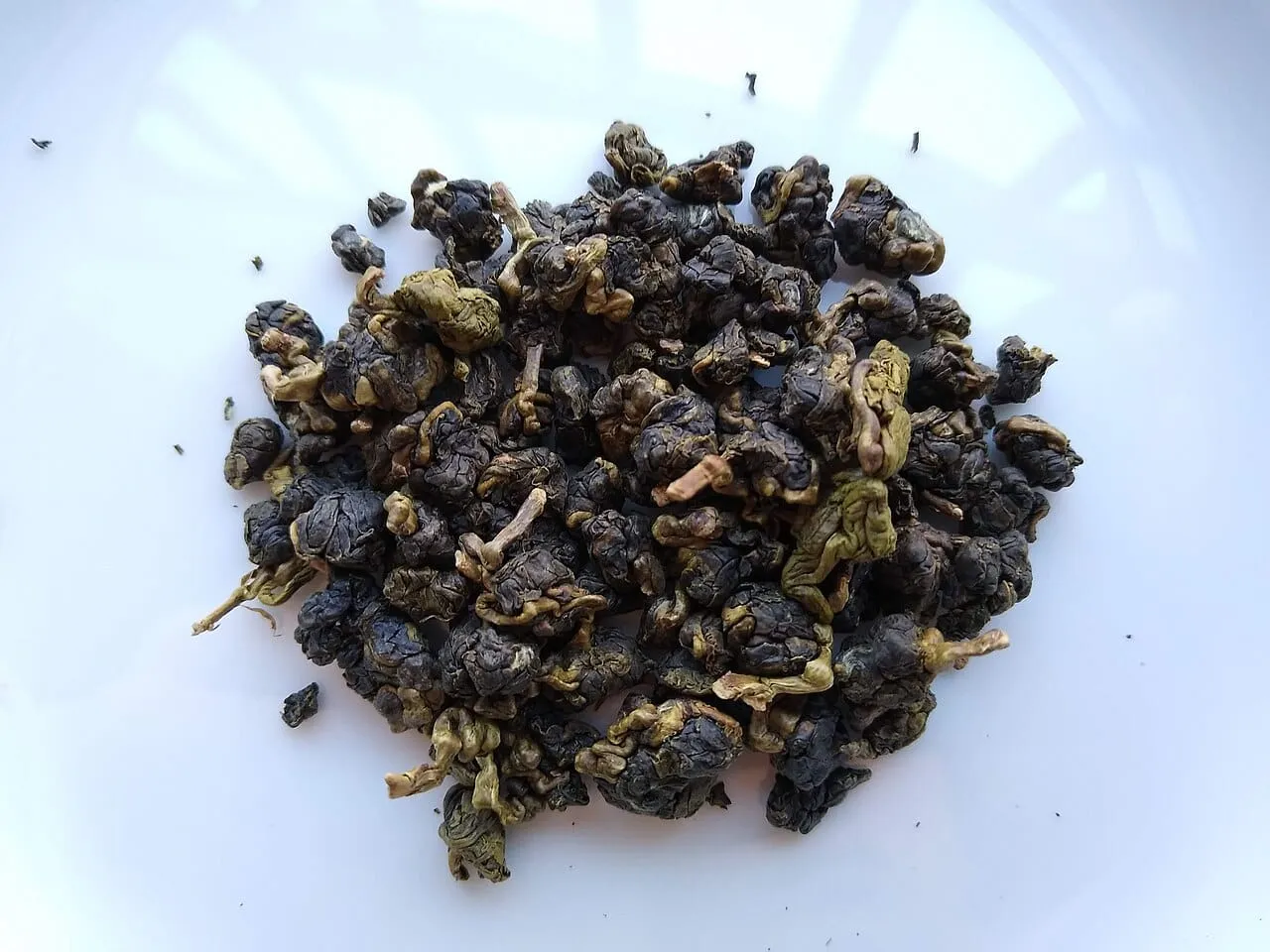
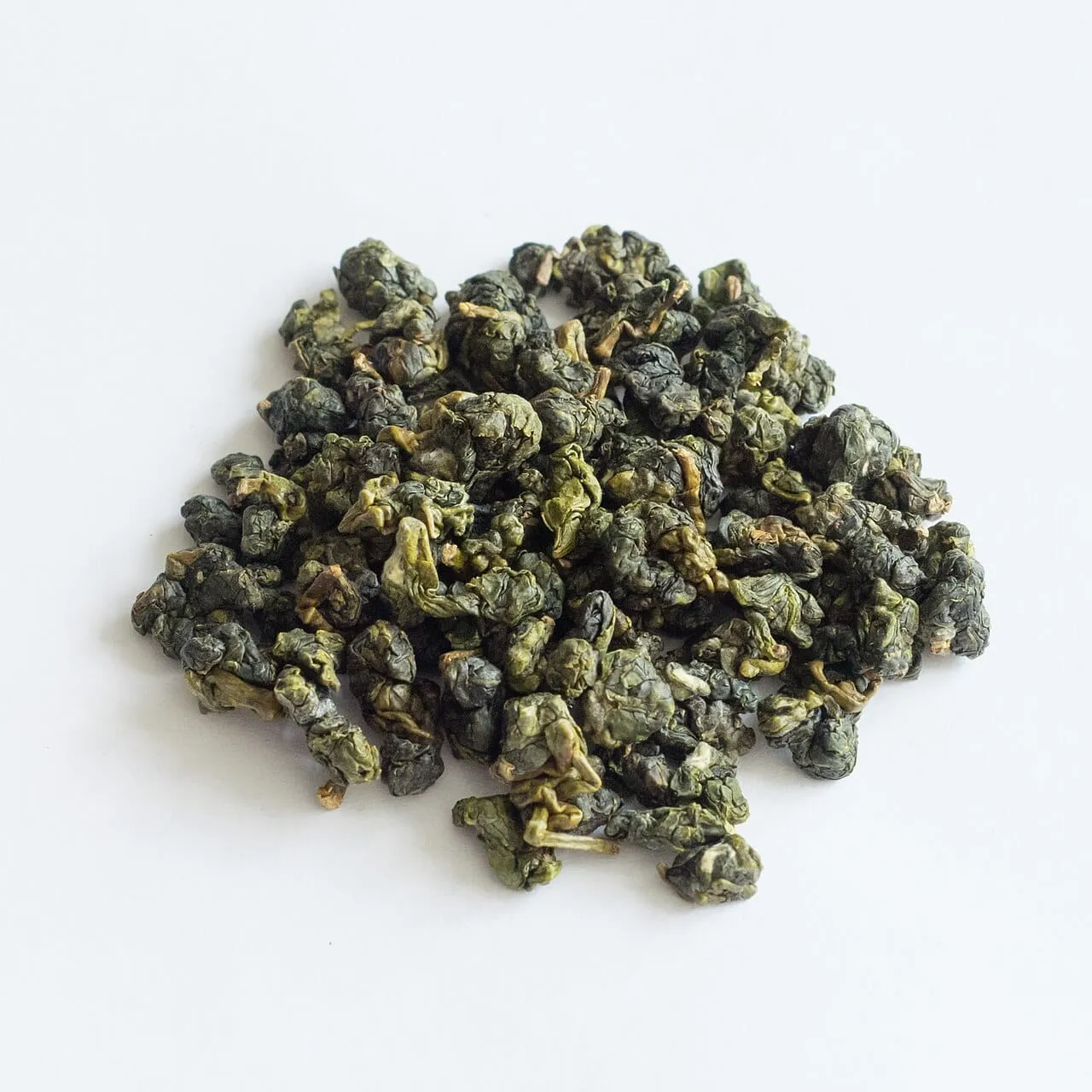
Scoop up dry unroasted Taiwan High-Mountain Oolong and the dense, tightly curled hemispheres feel firm and springy, glistening deep jade-green rather than dark mahogany[1][2]. Once steeped open in hot water, the plump leaves reveal none of the broad crimson border typical of heavily turned Wuyi rock tea—at most a faint rosy-amber blush along notched margins[1]. While foggy mountain ridges help lay down slow-grown fleshy shoots, turning raw highland leaves into crisp floral lift and supple, lingering broth relies directly on cool, light bruising, multi-cycle cloth-ball rolling, and thoughtful finishing heat.
1. Taxonomy, Sensory Authentication & Altitude Evidence
1.1 Standards and Taiwan’s Sensory Wheel Ecosystem
In commercial and technical taxonomy, Taiwan’s tight rolled highland styles fall under Taiwan-style oolong tea, framed by national specification GB/T 39563-2020 for tight hemispherical morphology, moisture ceilings, and baseline sensory classification[1]. Within Taiwan, the Tea Research and Extension Station (TRES) constructed six standardized sensory wheels alongside the Taiwan-tea Assortment and Grading system (TAGs) covering eight regional specialty styles—including High-Mountain Oolong, Dongding, and Oriental Beauty—encouraging drinkers and judges to distinguish lifted green floral fragrance, herbaceous freshness, roasted caramel balance, and mouthfeel cleanly rather than equating mountain names mechanically with cup merit[2].
1.2 What High Altitude Actually Changes—and What Remains Cultivar-Bound
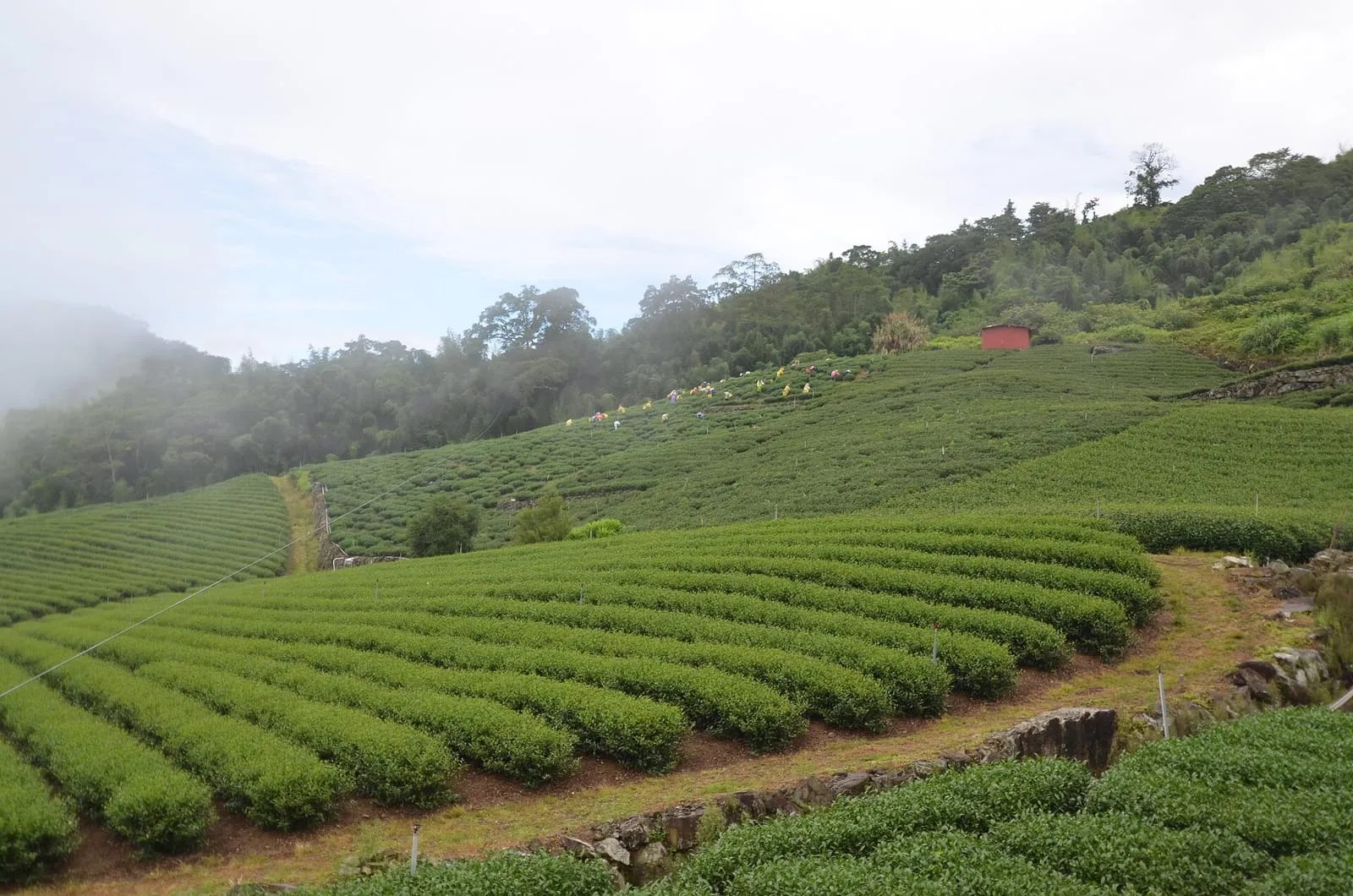
Growing tea above roughly 1,000 meters across Alishan, Shanlinxi, Lishan, and Dayuling exposes bushes to cool nights, diffuse afternoon mist, and slower vegetative elongation. Yet analytical chemistry reveals that elevation modifies specific compounds rather than erasing plant genetics.
In a 2025 comparison evaluating six distinct tea cultivars grown and processed across high- vs. low-altitude sites (Li et al., 2025)[3]:
- Consistent Altitude Gains: High-altitude oolongs exhibited lifted sensory ratings for umami, sweetness, and floral intensity, paired generally with higher total free amino acids, polyphenols, and soluble sugars[3];
- Specific Monoterpene vs. Cultivar Partition: Across 55 shared volatile compounds (and 22 key discriminants narrowed via PLS-DA and rOAV), only linalool, linalool oxide II, and geraniol consistently increased under high-altitude cultivation, whereas the majority of remaining volatiles continued to depend predominantly on cultivar genetics[3].
Simply put, mountain microclimate bolsters specific sweet amino acids and floral monoterpenols atop a cultivar blueprint—typically Qingxin Oolong or Jinxuan (TTES No. 12). Turning that biological raw material into clean mountain cup character still hinges on disciplined craft at the factory tray.
Altitude Microclimate & Light Zuoqing Oxidation
Stage 01: mountain mist >= 1,000 m; Stage 02: cool gentle shaking.
Cool misty slopes ≥ 1,000 m build fleshy blades and floral precursors
- Steep ridges & mountain basins trap afternoon fog
- Drifting mist softens direct afternoon solar glare
- Contour terraces slow run-off and retain chill night air
- Shoots stay thick, juicy, and high in floral monoterpenes
Altitude & diffuse cloud cover delay fiber stiffening while working alongside cultivar traits.
Craft conditions, standards & evidence limits
- Environment
- Misty slopes ≥1,000 m with diffuse sunlight & cool nights
- Timing
- Slow spring/winter shoot maturation; gentle short solar withering
- Moisture
- ~75% fresh → supple relaxed shoots before indoor rack rest
- Leaf state
- Thick fleshy blades with ample pectin and soluble sugars
Cloud cover and lower mountain temperatures slow lignification; paired six-cultivar altitude studies observe elevated floral monoterpenes (linalool, geraniol) and higher sweetness/umami alongside strong cultivar influence.
Thin outdoor withering during brief clear morning windows, backed by gentle warm-air assist when misty
Standard framework: GB/T 39563-2020 (Taiwan-style Oolong Tea) and TRES Taiwan-tea Assortment & Grading System (TAGs).
Altitude alone never guarantees aroma without suitable cultivar, sunlight-withering window, cool indoor airflow, and attentive roasting.
2. Cool Light Zuoqing & Canvas Cloth-Ball Shaping
Positioned at the light end of oolong oxidation, High-Mountain Oolong pursues bright green-leaf core with faint marginal blush rather than broad heavy fermentation. The craft progresses through controlled opening-bud plucking → gentle solar dehydration → cool ventilated resting/light tumbling (zuoqing) → pan fixation → primary rolling/drying → iterative canvas cloth-ball rolling (baorou) and un-clumping ventilation → final drying and optional roasting[1][4][5].
2.1 How Cool Resting & Gentle Shaking Clear Grassiness Without Darkening Liquor
Thick highland Qingxin and Jinxuan shoots hold high internal leaf water. After moderate outdoor solar wilting triggers leaf softness, shifting trays into cool ventilated rooms (using cool mountain night air or climate-controlled rooms during warm harvests) achieves two critical objectives:
- Vascular Moisture Redistribution: Stems slowly feed internal moisture toward transpiring leaf edges without slamming enzymatic browning across the whole mesophyll. Light tossing restricts cell disruption to delicate serrations along leaf margins[4];
- Enzymatic Pathway Redirection: Physical stress and controlled dehydration coordinate lipoxygenase (LOX) lipid cleavage and glycoside hydrolysis[4][5]. Tracking volatile remodeling across Jinxuan and Qingxin Oolong processing lines, Lin et al. (2021) demonstrated how withering and zuoqing stages dynamically modulate terpenols, esters, and green-leaf volatiles distinctly by cultivar[5]. High-Mountain Oolong halts fixation before deep catechin polymers weigh down transparency, preserving crisp floral-fruity aromatics over a clear amber-gold-green cup.
2.2 Cloth-Ball Rolling (Baorou): Soft Plasticity & Essential De-Clumping
Once pan fixation stabilizes enzyme activity and initial rolling forms loose strips, slightly dried warm leaves enter tight canvas bags for cloth-ball rolling (baorou). Alternating compression and rotation coerces pliable strips into tight hemispheres, governed by three practical control principles:
- Adjust Cycles to Leaf State, Not Fixed Folklore Counts: Rolling repetitions vary continuously with leaf thickness, post-fixation water distribution, and press geometry; prescribing a fixed universal cycle count like “15–30 presses” mistakes workshop adjustment for an invariant rule;
- De-Clumping (Jiekuai) Prevents Core Steaming: Mechanical friction generates internal heat inside dense canvas balls. Unwrapping, breaking tea clumps apart, and venting steam/heat prevent stale men-huang core scorching (“red-heart dullness”) that spoils floral brightness;
- Pellet Tightness Alters Diffusion Timing—Not Magic Pectin Barriers: Compact hemispheres hydrate progressively outward across early infusions, shifting kinetic extraction timing; describing hydration kinetics accurately needs no unverified “pectin film burst” mythology or invented cell-rupture figures.
3. Unroasted Clarity vs. Light Roasting Balance
Contemporary High-Mountain Oolong frequently pauses immediately after drying without subsequent roasting to spotlight sharp crisp qingxiang florals; conversely, classic winter-oriented or storage-intended lots undergo gentle low-to-light basket/oven resting to tame raw edginess and stabilize keeping quality[1][6].
Cloth-Ball Hemisphere Rolling & Roast Balance
Stage 03: cloth-ball compression; Stage 04: unroasted vs. light-roast tasting.
Warm canvas bundle compression coils whole shoots into dense hemispheres
- Twisted canvas sack gathers fixed & rolled leaves tightly
- Rhythmic pressing + unclumping compresses strips gently
- Dense spherical green-jade granules reduce storage breakage
- Steep-ready structure unfurls stepwise in near-boiling water
Repeated pressing and cooling turns loose strips into aromatic tight Taiwan granules.
Craft conditions, standards & evidence limits
- Environment
- Hot pan/drum fixation followed by warm canvas cloth-ball tumbling (tuanyou)
- Timing
- Iterative tight cloth-ball pressing interleaved with unclumping and cooling
- Moisture
- Stepped moisture removal down toward ~5% dry stability
- Leaf state
- Dense emerald-jade semi-hemisphere granules that unfurl into intact whole leaves
Under GB/T 39563-2020, tightly rolled hemisphere granules define classic Taiwanese rolled oolong, slowing aromatic loss in storage and pacing multi-infusion extraction in a gaiwan.
Fabric bundle twisting compresses the leaf mass without tearing cell walls or crushing the margin
Standard framework: GB/T 39563-2020 (Taiwan-style Oolong Tea) and TRES Taiwan-tea Assortment & Grading System (TAGs).
Altitude alone never guarantees aroma without suitable cultivar, sunlight-withering window, cool indoor airflow, and attentive roasting.
Multi-sample analytical comparisons help demystify the sensory trade-off between unroasted and roasted expressions:
- 153 Roasted & Unroasted Oolong Fingerprints (Wang et al., 2023): Profiling 153 oolongs across High-Mountain (HMT), Tieguanyin (TGYT), Dongding (DDT), and Wuyi Rock (WRT) revealed 128 volatile compounds. Overall, unroasted teas preserved fresher, greener floral brightness, whereas roasting generated broader volatile complexity alongside caramel and sharper roasted-pungent facets[6]. High-Mountain Oolongs separated distinctly around elevated linalool and geraniol signatures, contrasting sharply with Dongding’s Maillard pyrazines/pyrroles and Wuyi Rock’s ionones and cyclocitral markers[6].
- Thermal Shifts & Whole-Matrix Taste Synergy: Tracing Qingxin Oolong across graded roasting treatments, Lan et al. (2022) recorded coordinated shifts across phenolic profiles and aroma-active fractions[8]; complementary broad-spectrum metabolomics (Feng et al., 2024)[7] and quantitative taste recombination/omission work on oolongs (Yu et al., 2025, examining Dongding and Rougui matrices)[9] reinforce that perceived cup sweetness, lingering fullness, and soft throat sensation emerge from balanced non-volatile suites (amino acids, caffeine, flavonol glycosides, catechins, organic acids) rather than a single isolated compound[7][9].
| Stylistic Attribute | Unroasted (Qingxiang) High-Mountain | Lightly Roasted High-Mountain Oolong | Evidence & Interpretation Boundary |
|---|---|---|---|
| Dry Leaf & Liquor Tone | Vibrant emerald-jade; luminous green-gold liquor | Deeper olive-moss; clearer amber-gold cup | Moderate heating drops residual moisture and softly matures leaf tone[6][8] |
| Volatile Aroma Emphasis | Prominent linalool, geraniol, fresh lifted florals & crisp fruit[3][6] | Melded warm floral-honey plus gentle Maillard toasted nuances[6][8] | Gentle low-heat resting retains core monoterpenes while excess heat dulls brightness[6] |
| Palate Feel & Bitterness Edge | Crisp brisk briskness and cooling lift; heavy dosage can highlight slight green snap | Rounded broth sweetness with moderated raw catechin bite | Perceived smoothness also shifts sharply with water ratio and leaf maturity[8][9] |
| Ambient Shelf Stability | Vulnerable to moisture ingress, oxygen fading, and sour staleness | Lower final water activity slows aroma loss and stale drift | Unroasted high-mountain lots perform best in high-barrier chilled/nitrogen-flushed pouches |
4. Integrated Trajectory & Sensory Snapshot
Connecting mountain cultivar accumulation, cool light bruising, cloth-ball compaction, and optional roasting maps the full cup behavior of Taiwan High-Mountain Oolong:
Taiwan High-Mountain Oolong
Oolong · Light-Oxidized Highland Hemisphere5. Adjustable Brewing Starting Points & Comparative Practice
Because rolled hemispheres begin tight and take time to unfurl cleanly across infusions, adjust water temperature, ratio, and vessel retention smoothly as flexible starting tools:
- White Porcelain Gaiwan or Thin Clay Pot (Balanced Everyday Starting Point):
- Measure
5–7 gdry pellets into a110–130 mLporcelain gaiwan (covering the floor neatly in a thin mound); - Start with
92–96 °Cwater (feel free to push to98–100 °Cboiling pours for crisp winter lots or when seeking higher aroma projection); - Infuse the opening steep for roughly
35–50 sto allow pellets to hydrate and begin opening, tighten the second infusion to25–35 sonce leaves expand halfway to capture peak floral clarity, and extend progressively by10–15 sthereafter.
- Measure
- Side-by-Side Trio Tasting Exercise:
- Line up three identical small porcelain gaiwans: (A) Unroasted Qingxin High-Mountain Oolong, (B) Lightly Roasted High-Mountain or Jinxuan batch, and (C) Medium-Roasted Dongding Oolong;
- Steep all three simultaneously at matched
~1:20leaf ratios and temperature; - Inspect infused leaves for near-absent vs. moderate edge redness, compare cooled porcelain-lid fragrance (cool linalool lift vs. warm caramel-pyrazine balance), and trace mouthfeel changes as the tea cools toward lukewarm.
6. Common Myths & Scientific Clarifications
Myth 1: “Elevation guarantees everything—above 2,000 meters, any tea leaf naturally turns into legendary mountain tea regardless of craft.”
Scientific Clarification: Six-cultivar elevation trials verify consistent highland gains in linalool, linalool oxide II, geraniol, and amino richness[3], yet cultivar identity and careful processing still govern most aroma complexity. Waterlogged rainy harvests or careless overheated rolling quickly spoil even the highest mountain slope batch.
Myth 2: “Authentic Taiwan High-Mountain Oolong must never be roasted—any fire kills its mountain spirit.”
Scientific Clarification: Profiling across 153 oolongs confirms that unroasted and roasted approaches simply explore distinct aroma–stability equilibria rather than right vs. wrong[6][8]. Unroasted lots maximize crisp green floral radiance for prompt drinking, while skilled light resting extends shelf freshness and smoothes subtle catechin edges.
Myth 3: “Top-grade High-Mountain Oolong must stay 100% pure green along every edge with zero reddish margin.”
Scientific Clarification: Completely bypassing mild edge abrasion during light zuoqing leaves volatile green alcohols unvented and produces brittle green strips that fracture easily under canvas rolling. Traditional excellence seeks vivid green leaf centers balanced by whisper-thin reddish margins—controlled oxidation stopped early, not non-oxidation[1][4].
Myth 4: “Rolling pellets denser through fixed 25+ cloth-ball cycles always proves finer craft and guarantees more steeps.”
Scientific Clarification: Compression cycles follow leaf fleshiness, initial moisture distribution, and cooling intervals rather than fixed ritual numbers. Excessive mechanical crushing bruises interiors, clouding early steeps with broken dust without magically extending total soluble extract.
7. Related Articles
- Dongding Oolong: Roasting Divergence, Cloth-Ball Rolling & Taste Recombination
- Oriental Beauty: Leafhopper Herbivory Ecology & Heavy Zuoqing
- Anxi Tieguanyin: Rhythmic Tossing Dehydration & Qingxiang vs. Traditional Styles
- Science of Oolong Zuoqing
- Composition and Flavour Science
References
- R-334 State Administration for Market Regulation & Standardization Administration of China. GB/T 39563-2020 Taiwan-Style Oolong Tea. Beijing: Standards Press of China, 2020. https://openstd.samr.gov.cn/bzgk/std/newGbInfo?hcno=A60DC75862947B51B76CF9C5630FBD6D
- R-431 Su T, Yang M, Huang H, et al. Using Sensory Wheels to Characterize Consumers’ Perception for Authentication of Taiwan Specialty Teas. Foods, 2021, 10(4): 836. https://doi.org/10.3390/foods10040836
- R-429 Li Y, Shao S, Deng S, et al. Comparison of Flavor Characteristics and Metabolite Basis of Oolong Tea from Six Different Tea Plant Cultivars Under High- and Low-Altitude Conditions. Plants, 2025, 15(1): 23. https://doi.org/10.3390/plants15010023
- R-301 Hu CJ, Li D, Ma YX, et al. Formation mechanism of the oolong tea characteristic aroma during bruising and withering treatment. Food Chemistry, 2018, 269: 202–211. https://doi.org/10.1016/j.foodchem.2018.07.016
- R-206 Lin J, et al. Study of aroma compound formations and transformations during Jinxuan and Qingxin oolong tea processing. International Journal of Food Science & Technology, 2021, 57(3): 1629–1638. https://doi.org/10.1111/ijfs.15205
- R-430 Wang D, Liu Z, Chen W, et al. Comparative study of the volatile fingerprints of roasted and unroasted oolong tea by sensory profiling and HS-SPME-GC-MS. Current Research in Food Science, 2023, 6: 100442. https://doi.org/10.1016/j.crfs.2023.100442
- R-375 Feng XX, Wang H, Yu Y, et al. Exploration of the flavor diversity of oolong teas: A comprehensive analysis using metabolomics, quantification techniques, and sensory evaluation. Food Research International, 2024, 195: 114868. https://doi.org/10.1016/j.foodres.2024.114868
- R-374 Lan X, Liu Z, Wang D, et al. Characterization of volatile composition, aroma-active compounds and phenolic profile of Qingxin oolong tea with different roasting degrees. Food Bioscience, 2022, 50: 101985. https://doi.org/10.1016/j.fbio.2022.101985
- R-372 Yu Y, Liu R, Wang H, et al. Identification of Key Taste-Active Compounds in Oolong Teas (Dongding and Rougui) by Quantitative Measurements, Recombination Experiments, and Omission Tests. Journal of Agricultural and Food Chemistry, 2025, 73(33): 21082–21095. https://doi.org/10.1021/acs.jafc.5c06990
Article Knowledge Network
Explore the connections between the teas, processes and flavours in this article.