
Start with the essentials
Assam’s rich malty character, Darjeeling’s seasonal floral and muscatel associations, and Nilgiri’s softer fruity styles reveal different sides of Indian tea. Why might one suit milk while another invite attention as a plain infusion?
This article connects three regions’ terrain and climate with plant material, harvesting seasons and manufacture, including Orthodox leaf tea and CTC particles. Industry and trade provide further context, making origin, season and leaf form more useful when choosing and brewing.
Three key points
- Origins offer different cluesAssam often suggests strength and malt, Darjeeling seasonal change, and Nilgiri varied plain-drinking and blending styles.
- Season adds another distinctionDarjeeling’s first and later flushes differ, so origin alone does not describe a batch.
- Manufacture changes preparationOrthodox rolling and CTC processing produce different leaf forms and extraction rhythms.
Connect the region with the tea
Find the origin, flush and Orthodox or CTC description on a package. Taste it plain before trying milk if that suits your habits, recording aroma and strength so the label connects with experience.
Why this country matters
British colonialism and the birth of Indian tea
The rise of Indian tea is inseparable from British colonial history. In the early 19th century the British East India Company’s dependence on Chinese tea deepened, and the resulting trade deficit spurred a search for an alternative source. In 1823 the British explorer Robert Bruce discovered indigenous tea trees growing wild in the Assam jungle — later identified as Camellia sinensis var. assamica [1]. This discovery rewrote the global tea map.
In 1834 the British established the Tea Committee in India, systematically importing Chinese seeds, plants and processing know-how and opening the first commercial gardens in Assam. By 1838 the first eight chests of Assam tea arrived in London for auction, marking India’s formal entry into the international market [2]. The Scottish botanist Robert Fortune was later dispatched to China in 1848 to acquire seeds, seedlings and manufacturing secrets, further accelerating the technical base of the Indian industry [3].
From the late 19th century into the 20th, Indian tea moved from hand manufacture to mechanisation. In the 1930s Sir William McKercher invented the CTC (crush-tear-curl) process at the Amgoorie estate in Assam. A pair of toothed rollers macerate withered leaf into tiny granules, dramatically speeding oxidation and producing a much stronger, faster-drawing cup [4]. CTC spread rapidly after the 1950s and now accounts for more than 80 % of Indian black-tea output [4], forming the backbone of India’s competitiveness in world trade.
India’s place in global trade
According to the Tea Board of India and FAO FAOSTAT, India produces roughly 1.3–1.4 billion kg of tea per year, about 20–22 % of world output, with black tea overwhelmingly dominant [5][6]. Annual exports are in the range of 200–250 million kg, with Russia, the UK, the Middle East, Germany and the United States as principal markets. Darjeeling, despite representing only ~1 % of Indian production, commands a steep price premium on the world market; its Geographical Indication (GI) protection system is among the strictest in the tea world [7].
Three terroirs
Assam: the power of the lowlands
India Three Tea Regions Terroir & Elevation Workbench
Compare Assam (Brahmaputra lowlands, tropical monsoon, bold malty punch), Darjeeling (Himalayan alpine altitude, cool mist, muscatel champagne profile), and Nilgiri (Southern Blue Mountains, dual-monsoon, smooth and bright fruity body).
About this diagram & its limits
India three tea regions terroir and altitude comparison illustration · Illustrates elevation, rainfall, and muscatel/malty flavor spectrum distinctions across Assam, Darjeeling, and Nilgiri; micro-climates vary across single estates.
Assam Region (Brahmaputra Lowlands)
World's largest single black tea growing regionThe Brahmaputra River nurtures rich alluvial soils beneath tropical monsoon rains, producing fast-growing large leaves rich in catechins and theaflavins.
Darjeeling Region (Himalayan Highlands)
The legendary "Champagne of Teas"Nestled on steep Himalayan ridges under shifting cloud banks. Alpine UV radiation and wide diurnal temperatures slow shoot growth, locking in delicate ethereal monoterpenes.
Nilgiri Region (Southern Blue Mountains)
South Indian dual-monsoon high plateauCrowned by the high peaks of the Western Ghats, kissed by dual monsoon winds. Mild temperate weather delivers balanced, fragrant black teas with gentle tannins.
The map above compares the terroir of India’s three tea regions: Assam lies on the lowland floodplains of the Brahmaputra, hot and humid under the tropical monsoon; Darjeeling sits on the Himalayan foothills at 600–2,200 m, cool and misty; Nilgiri, in the southern Western Ghats, enjoys a mild, wet climate and year-round plucking. Click a region tab to watch altitude, rainfall and temperature change.
The Assam tea belt lies in north-eastern India on the alluvial plains of the Brahmaputra River, at elevations of 50–300 m. The climate is tropical monsoon: mean annual temperatures 24–35 °C, rainfall 2,000–4,000 mm, with a concentrated wet season from June to September and a relatively dry period from November to February [8].
Soils are deep, well-drained alluvials rich in organic matter. The dominant plant is Camellia sinensis var. assamica, a large-leaf tree-type variety whose high polyphenol content makes it ideal for bold, strong black teas [8]. Assam’s second flush (June–August) is generally considered the best season: after the spring growth flush, the bushes have accumulated ample nutrients, yielding a fuller, more malty cup.
Plucking runs from March to November; peak-monsoon weeks are usually avoided because excessive rain dilutes quality. The standard plucking standard is two leaves and a bud; premium lots are picked more finely, with a high proportion of tippy golden buds.
Darjeeling: the “Champagne of teas” in the Himalaya
Darjeeling sits in the northern part of West Bengal state on the Himalayan foothills, at 600–2,200 m — the highest tea zone in India. Mean temperatures are 15–25 °C, rainfall 1,500–3,200 mm, and orographic lifting keeps the gardens shrouded in mist for much of the year, with large day–night temperature swings [9].
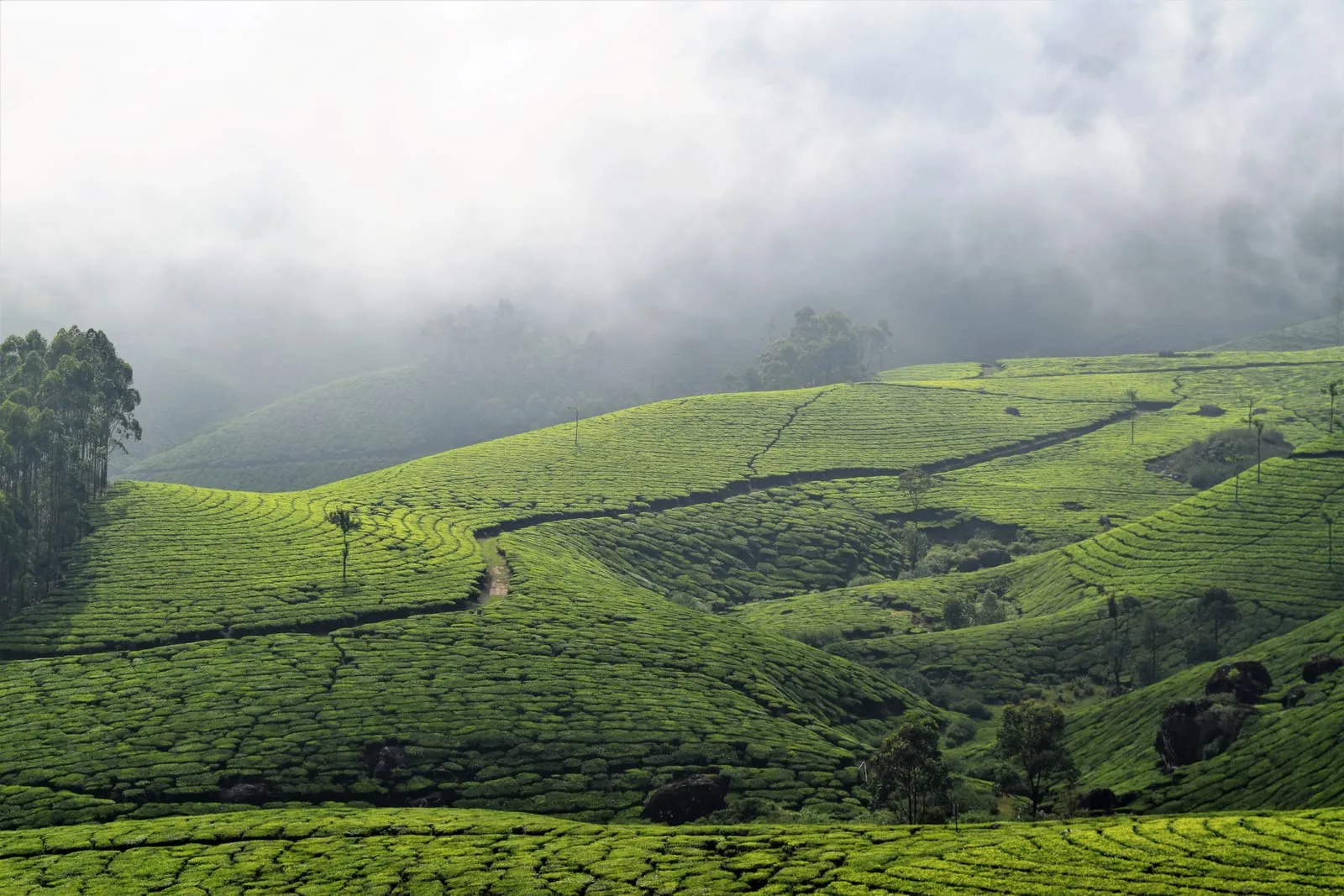
Acidic loam and sandy loam soils drain freely. The cool, slow-growing conditions produce thinner leaves with richer amino-acid and aromatic profiles [9]. Darjeeling gardens grow mainly Camellia sinensis var. sinensis (Chinese small-leaf type) and hybrids with assamica, giving the teas their trademark delicacy and complexity.
Darjeeling harvests are organised by flush — the seasonal plucking round [10]:
| Flush | Timing | Character | Flavour profile |
|---|---|---|---|
| First Flush | March–April | Very young buds, light oxidation | Crisp, floral, slightly astringent |
| Second Flush | May–June | Warmer weather, fuller oxidation | Muscatel, ripe fruit, rich body |
| Autumnal | October–November | Post-monsoon, wide diurnal range | Round, sweet, lightly nutty |
Values are representative ranges; exact timing and character vary by estate elevation, aspect and micro-climate [10].
Because of its tiny output and exceptional quality, Darjeeling is often called the “Champagne of teas”. The name “Darjeeling” itself is protected under India’s Geographical Indication of Goods Act; only tea grown and processed within the defined Darjeeling area may bear the name [7].
Nilgiri: the year-round south
The Nilgiri tea district lies in Tamil Nadu state on the southern slopes of the Western Ghats, at 300–2,000 m. Mean temperatures 18–28 °C, rainfall 1,500–2,500 mm, with both the south-west and north-east monsoons bringing moisture — there is no true dry season [11].
The mild, stable climate allows year-round plucking, earning Nilgiri the nickname “the all-season tea district”. Red lateritic and forest soils are rich in organic matter. Plantings are chiefly var. assamica and its hybrids, but the cooler, gentler conditions yield a softer, more rounded, faintly fruity cup than the muscular teas of Assam.
Historically Nilgiri was a blending base for English Breakfast and other commercial blends. In recent years the rise of single-origin speciality tea has prompted Nilgiri estates to release premium own-brand teas, valued for their clean, consistent flavour.
Processing: CTC vs Orthodox
Indian black tea is manufactured in two principal systems — CTC and Orthodox — whose critical divergence is in the rolling / maceration step. This choice governs leaf appearance, oxidation speed and brewing behaviour [4][12].
CTC: efficiency and strength
CTC (crush-tear-curl), invented by Sir William McKercher in the 1930s, uses counter-rotating toothed rollers to macerate withered leaf into 0.5–2 mm granules [4]. The extreme cell breakage brings polyphenol oxidase (PPO) into intimate contact with its substrates, so oxidation proceeds far faster than in orthodox manufacture.
Research shows that CTC teas reach peak theaflavin levels after roughly 20 minutes of oxidation, then theaflavins rapidly convert to thearubigins; total catechins fall by about 96 % from fresh leaf to finished tea [12]. The small particle size gives extremely rapid infusion and a strong, brisk liquor — ideal for milk tea and tea-bag production. Today CTC makes up more than 80 % of Indian black-tea output and dominates export volume [4].
Orthodox: tradition and terroir
Orthodox manufacture preserves the classic wither-roll-oxidize-dry sequence, producing twisted whole-leaf or broken-leaf grades. Lower cell breakage means slower, more controllable oxidation, which in turn preserves the subtle site-specific aromatics — the muscatel of Darjeeling, the malt of Assam, the soft fruit of Nilgiri — in a way that CTC cannot fully replicate.
Orthodox oxidation typically lasts longer than CTC (60–120 min versus 20–45 min) and drying temperatures are somewhat lower, protecting volatile aromatic compounds [12]. Premium Darjeeling and a growing share of fine Assam teas are made this way, targeting the mid-to-high-end market that values flavour complexity.
Tea varieties and the science behind the cup
The distribution of tea varieties across India’s three regions profoundly shapes the flavour of each cup [13]:
Indian Tea Varieties, Elevation Ladder & Cup Profiles
Compare Assam (Brahmaputra lowlands, tropical monsoon, bold malty punch), Darjeeling (Himalayan alpine altitude, cool mist, muscatel champagne profile), and Nilgiri (Southern Blue Mountains, dual-monsoon, smooth and bright fruity body).
About this diagram & its limits
India three tea regions terroir and altitude comparison illustration · Illustrates elevation, rainfall, and muscatel/malty flavor spectrum distinctions across Assam, Darjeeling, and Nilgiri; micro-climates vary across single estates.
Assam Region (Brahmaputra Lowlands)
World's largest single black tea growing regionThe Brahmaputra River nurtures rich alluvial soils beneath tropical monsoon rains, producing fast-growing large leaves rich in catechins and theaflavins.
Darjeeling Region (Himalayan Highlands)
The legendary "Champagne of Teas"Nestled on steep Himalayan ridges under shifting cloud banks. Alpine UV radiation and wide diurnal temperatures slow shoot growth, locking in delicate ethereal monoterpenes.
Nilgiri Region (Southern Blue Mountains)
South Indian dual-monsoon high plateauCrowned by the high peaks of the Western Ghats, kissed by dual monsoon winds. Mild temperate weather delivers balanced, fragrant black teas with gentle tannins.
| Region | Dominant variety | Leaf character | Biochemistry | Typical product |
|---|---|---|---|---|
| Assam | var. assamica | Large, thick, leathery | High polyphenols, moderate amino acids | Bold black tea, CTC |
| Darjeeling | var. sinensis × assamica | Medium, relatively thin | High amino acids, rich aromatics | Delicate black, oolong-style |
| Nilgiri | var. assamica dominant | Large, medium thickness | Moderate-high polyphenols, balanced | Black tea, blending base |
Values are representative ranges; actual figures vary by cultivar and garden management [13].
Camellia sinensis var. assamica is a tree-type large-leaf variety native to north-eastern India and southern Yunnan. It tolerates heat and humidity, and its polyphenol content can reach 25–35 % dry weight, making it ideal for strong black tea [13]. Camellia sinensis var. sinensis is a shrub-type small-leaf form with better cold tolerance, higher amino-acid and aromatic ratios, and is preferred for green tea and delicate black styles. The cool, high-elevation conditions of Darjeeling favour sinensis and its hybrids, which is one reason Darjeeling teas taste so much finer than lowland Assam teas [13].
Black-tea oxidation is fundamentally enzymatic oxidation: rolling or CTC maceration ruptures leaf cells, allowing polyphenol oxidase (PPO) to oxidise catechins to ortho-quinones, which then couple and polymerise into theaflavins and thearubigins [14]. Theaflavins give brightness and briskness; thearubigins contribute depth and the red-brown colour. Because CTC breaks cells more thoroughly, theaflavin formation is faster but also decays faster, so CTC manufacture requires tighter oxidation control to avoid over-oxidation [12].
Flavour and quality formation
The three regions produce strikingly different flavour profiles:
Assam · Flavour Profile
Darjeeling · Flavour Profile
Nilgiri · Flavour Profile
Profiles are schematic; actual character varies by estate, season, process and grade.
Common myths
- “All Indian tea is strong CTC broken tea.” [4] Darjeeling and a growing share of fine Assam are Orthodox whole-leaf teas with delicate, complex flavour worlds apart from CTC.
- “The more expensive the Darjeeling, the better.” [10] Each Darjeeling flush has a distinct personality — first flush is crisp and floral, second flush rich and muscatel, autumnal sweet and round. Price is not the only yardstick; personal preference matters more.
- “CTC is low-quality tea.” [4] CTC is a process choice, not a quality label. Well-made CTC from good leaf, with precise oxidation, is excellent for milk tea and daily drinking.
- “Indian tea needs no brewing care.” [10] Darjeeling first flush is best at 85–90 °C to protect its delicate aromatics; Assam CTC can take boiling water and a quick steep to deliver its bold punch.
- “Nilgiri is only a blending base.” [11] In recent years Nilgiri single-origin speciality teas have emerged, valued for their soft, clean, consistent character in the straight-tea market.
Related entries
- Gongfu Black Tea vs CTC Broken Tea — Deep comparison of CTC and Orthodox process principles and quality differences
- Botany of the Tea Plant — Morphological and biochemical differences between var. sinensis and var. assamica
- Science of Black Tea “Oxidation” — Enzymatic oxidation, theaflavin and thearubigin formation
- Country Focus · Sri Lankan Tea — British colonial tea heritage on a neighbouring island
- Country Focus · Kenyan Tea — The rise of a new black-tea power and its CTC industry
Full regional parameters
| Parameter | Assam | Darjeeling | Nilgiri |
|---|---|---|---|
| Altitude | 50–300 m | 600–2,200 m | 300–2,000 m |
| Mean temperature | 24–35 °C | 15–25 °C | 18–28 °C |
| Annual rainfall | 2,000–4,000 mm | 1,500–3,200 mm | 1,500–2,500 mm |
| Main plucking season | March–November | March–November (flushes) | Year-round |
| Dominant variety | var. assamica | var. sinensis × assamica | var. assamica dominant |
| Representative process | CTC dominant | Orthodox dominant | CTC + Orthodox |
| Typical flavour | Malty, brisk | Muscatel, floral, crisp | Smooth, fruity, round |
Values are representative ranges compiled from the Tea Board of India, FAOSTAT, ITC and regional research literature [5][6][8][9][10][11].
References
- R-247 — Tea Board of India. (2021). Tea Statistics of India and Quality Control Guidelines. Ministry of Commerce and Industry, Government of India. https://www.teaboard.gov.in/
- R-162 — Ukers, W. H. (1935). All About Tea (Vols. 1–2). The Tea and Coffee Trade Journal Company, New York. https://archive.org/details/AllAboutTeaV1
- R-023 — Fortune, R. (1847). Three Years’ Wanderings in the Northern Provinces of China, Including a Visit to the Tea, Silk, and Cotton Countries. John Murray, London. https://www.biodiversitylibrary.org/item/104642
- R-064 — Sarkar, S., Chowdhury, A., Das, S., Chakraborty, B., Mandal, P., & Chowdhury, M. (2016). Major tea processing practices in India. International Journal of Bioassays, 5(11), 5143–5150. https://doi.org/10.21746/ijbio.2016.11.0015
- R-233 — FAO. (2022). Global Tea Market: Current status and medium-term prospects to 2030. Food and Agriculture Organization of the United Nations, Rome. https://www.fao.org/markets-and-trade/commodities/tea/en/
- R-140 — Bore, J. K. (2008). The Effects of Mechanisation on Tea Quality in Kenya. Tea Research Foundation of Kenya.
- R-232 — FAO Intergovernmental Group on Tea. Current global market situation and emerging issues (CCP:TE 22/CRS 1), 2022. https://www.fao.org/3/cc0238en/cc0238en.pdf
- R-248 — 潮州市文化广电旅游体育局. 潮州工夫茶冲泡技艺(国家级非物质文化遗产代表性项目资料). 2008.
- R-234 — 中国农业科学院茶叶研究所 (2020).《中国茶树品种志与茶树种质资源评价》. http://www.tricaas.com/
- R-235 — Ho, C.-T., Zheng, X., & Li, S. (2015). Tea aroma formation. Food Science and Human Wellness, 4(1), 9–27. https://doi.org/10.1016/j.fshw.2015.04.001
- R-249 — Zhan Jia et al. (2018). The cultural connotation and inheritance of Gongfu tea in China. Journal of Tea Science.
- R-062 — Deka, H., Sarmah, P. P., Devi, A., Tamuly, P., & Karak, T. (2021). Changes in major catechins, caffeine, and antioxidant activity during CTC processing of black tea from North East India. RSC Advances, 11, 11457–11467. https://doi.org/10.1039/d0ra09529j
- R-250 — Tea Research Institute of Sri Lanka (TRI). (2020). Handbook on Tea Manufacture and Agronomy in Ceylon. Talawakelle, Sri Lanka. https://www.tri.lk/
- R-001 — Subramanian, N., et al. (1999). Role of Polyphenol Oxidase and Peroxidase in the Generation of Black Tea Theaflavins. Journal of Agricultural and Food Chemistry, 47(7), 2571–2578. https://doi.org/10.1021/jf9903301
Article Knowledge Network
Explore the connections between the teas, processes and flavours in this article.