
Start with the essentials
Ceylon remains a familiar origin name for Sri Lankan tea, covering high-, mid- and low-grown teas and several regional styles. Why might a package name Uva or Kandy, an elevation, or letters such as OP and BOP? These refer to different kinds of information.
This article connects elevation and monsoons with material and manufacture, then explains regional flavour clues, Orthodox and CTC methods, grading names and the Lion Logo.
Three key points
- Elevation works with seasonal conditionsBroad growing bands are a starting point; region, slopes and season add detail.
- Grade letters describe a systemOP and BOP help identify product form and specification within their context.
- Origin marks and tasting serve different purposesProvenance information and personal flavour preferences both need attention.
Connect the region with the tea
Separate region or elevation, grade letters and origin marks on a package. Brew for its actual leaf form, then record aroma, astringency and body to connect label information with the cup.
How altitude shapes flavour: the polyphenol–amino-acid trade-off
Sri Lanka Ceylon Tea Elevation & Monsoon Terroir Workbench
Adjust "Elevation (0–2,500 m)" and "Flavour Zones" to explore how central massif mountains and dual monsoons shape Low Grown (deep garnet, bold caramel malty), Mid Grown (orange-red, balanced fruitiness), and High Grown (bright golden, floral wintergreen mint) teas.
About this diagram & its limits
Sri Lanka Ceylon altitude and monsoon flavor zones illustration · Illustrates Low Grown (0–600m), Mid Grown (600–1200m), and High Grown (1200–2500m) transitions across temperature, rainfall, liquor color, and floral/malty notes.
High Grown Belt (1,200–2,500 m)
Ethereal high-altitude · Champagne of CeylonPerched on the highest slopes of the central massif. Sub-alpine temperatures slow bush metabolism, yielding delicate ethereal infusions rich in monoterpenes.
Mid Grown Belt (600–1,200 m)
Cradle of Ceylon tea historyKandy was where James Taylor planted the first commercial tea field in 1867. Generous rainfall produces well-rounded, robust teas that bridge light and bold styles.
Low Grown Belt (0–600 m)
Middle East favorite · Rich caramel maltTropical rain and fertile soils fuel vigorous bush growth. Heavy rolling and full oxidation produce dark leaves packed with sugars and polyphenols for intense caramel depth.
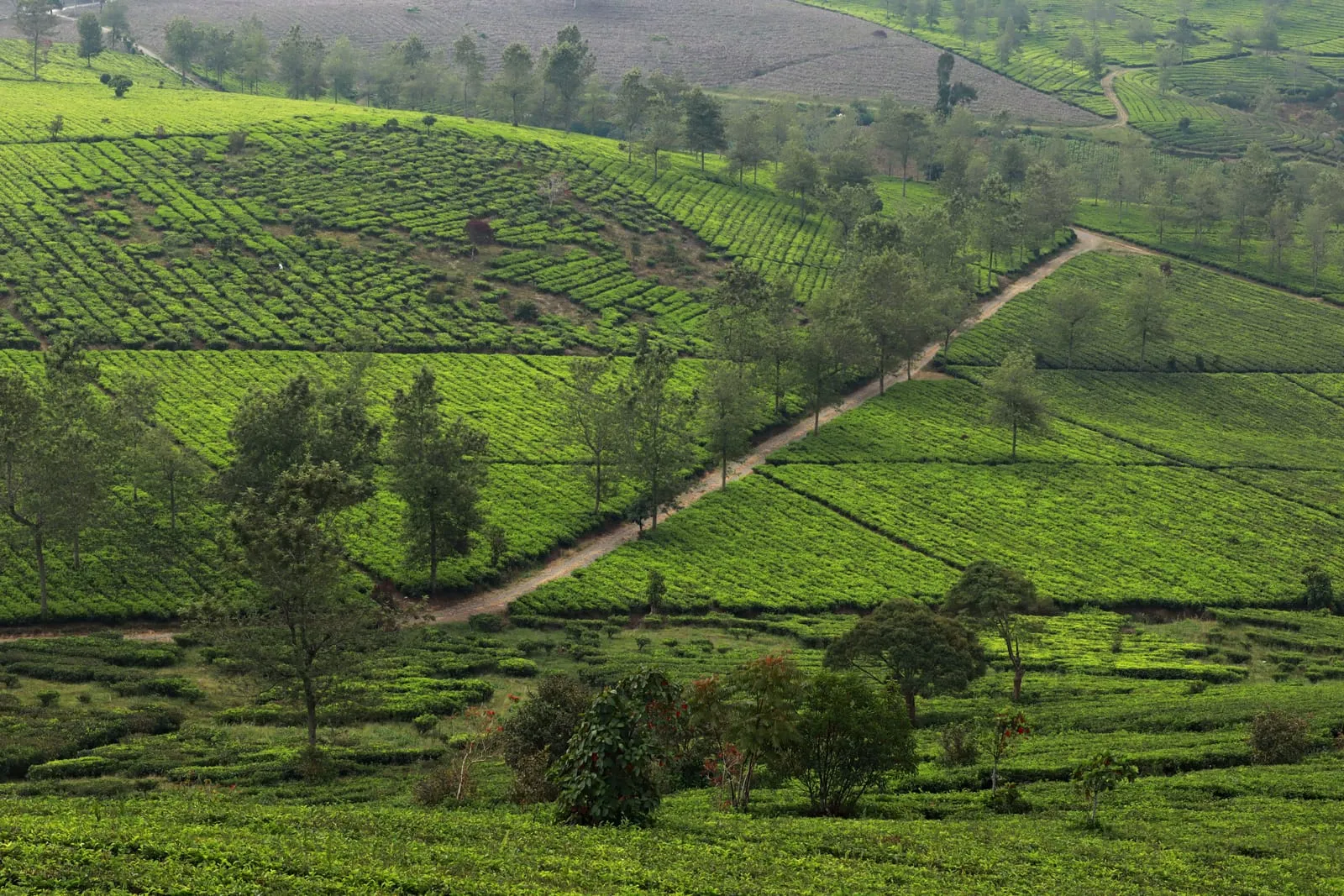
Altitude influences tea quality through a temperature- and light-driven biochemical trade-off.
Lower temperatures → slower growth → richer accumulation. At elevations above 1 200 m, where mean temperatures range from 10–18 °C, the tea bush’s growth cycle is significantly extended. Under cold stress, the plant accumulates more amino acids and soluble sugars as protective osmolytes, which translate into the fresh, sweet and mellow mouthfeel of the cup[4].
Stronger UV → higher polyphenols, but amino acids rise even faster. UV intensity increases with elevation, stimulating the synthesis of tea polyphenols as photoprotectants. However, research on Sri Lankan high-grown estates shows that the increase in amino acids (especially theanine) often outpaces that of polyphenols, so the polyphenol / amino-acid ratio actually decreases. This is the biochemical basis for the pronounced freshness of high-grown teas[4][5].
Wide diurnal temperature range → aroma enrichment. In Nuwara Eliya, day–night temperature differences can reach 15–20 °C. Sugars and aroma precursors accumulated during daytime photosynthesis are consumed more slowly at night, leading to higher concentrations in the leaf. This is also why high-grown teas frequently display marked floral and honey notes [5].
Monsoon and the Uva seasonal quality: weather as a flavour signature
Sri Lanka has a tropical monsoon climate governed by two alternating wind systems:
Sri Lanka Dual-Monsoon Map & Uva Seasonal Quality
Adjust "Elevation (0–2,500 m)" and "Flavour Zones" to explore how central massif mountains and dual monsoons shape Low Grown (deep garnet, bold caramel malty), Mid Grown (orange-red, balanced fruitiness), and High Grown (bright golden, floral wintergreen mint) teas.
About this diagram & its limits
Sri Lanka Ceylon altitude and monsoon flavor zones illustration · Illustrates Low Grown (0–600m), Mid Grown (600–1200m), and High Grown (1200–2500m) transitions across temperature, rainfall, liquor color, and floral/malty notes.
High Grown Belt (1,200–2,500 m)
Ethereal high-altitude · Champagne of CeylonPerched on the highest slopes of the central massif. Sub-alpine temperatures slow bush metabolism, yielding delicate ethereal infusions rich in monoterpenes.
Mid Grown Belt (600–1,200 m)
Cradle of Ceylon tea historyKandy was where James Taylor planted the first commercial tea field in 1867. Generous rainfall produces well-rounded, robust teas that bridge light and bold styles.
Low Grown Belt (0–600 m)
Middle East favorite · Rich caramel maltTropical rain and fertile soils fuel vigorous bush growth. Heavy rolling and full oxidation produce dark leaves packed with sugars and polyphenols for intense caramel depth.
- South-west monsoon (May–September): brings heavy rain to the south-west slopes and lowlands; the highlands lie in a rain shadow and remain relatively dry and cool.
- North-east monsoon (October–January): dry continental air picks up moisture as it crosses the Palk Strait, creating a distinctive micro-climate in the eastern highlands, especially Uva.
Uva seasonal quality is the most distinctive flavour phenomenon in Ceylon tea. During the July–September north-east monsoon, Uva estates experience a sharp drop in temperature, lower humidity and stronger sunshine. The bush, oscillating between stress and recovery, synthesises large amounts of linalool, geraniol and menthol—terpenoids that give Uva tea its unmistakable cooling mint and rose character[6]. This seasonal quality cannot be replicated by processing; it is a weather-written signature of terroir.
Plucking and processing: Orthodox and CTC side by side
Sri Lankan tea manufacture is overwhelmingly black tea, following two very different processing routes.
Orthodox
Withering → rolling → oxidation → drying, preserving the whole-leaf form. Orthodox tea accounts for roughly 30 % of Sri Lankan black-tea exports and is aimed at the premium and single-origin market. Nuwara Eliya, Uva and Dimbula specialty teas are almost exclusively Orthodox[7].
CTC (Crush-Tear-Curl)
Invented in the 1930s by Sir William McKercher, CTC uses rollers to cut, tear and curl leaf into granular particles, accelerating oxidation and increasing extraction efficiency. CTC makes up about 70 % of Sri Lankan output and is the main raw material for tea bags and blending; it produces a strong, dark-red liquor with rapid flavour release[7].
The Sri Lanka Tea Board enforces strict standards on processing hygiene, pesticide residues and grading. Finished tea is graded by traditional terms such as Pekoe, OP (Orange Pekoe), BOP (Broken Orange Pekoe), Fannings and Dust; larger leaf pieces denote higher grades[3].
Certification: the Lion Logo and GI protection
Sri Lanka was among the first tea-producing countries to establish a national origin-certification system.
Lion Logo: Launched by the Sri Lanka Tea Board in the mid-20th century, the Lion Logo may only be used on tea that is 100 % grown, processed and packed in Sri Lanka. It is the core mark of Ceylon-tea authenticity, protected under international intellectual-property law; any tea blended or repacked in a third country is ineligible[3].
ISO and organic certifications: The industry widely holds ISO 22000 and HACCP certifications, and a growing number of estates carry USDA Organic, EU Organic and Rainforest Alliance labels to meet demand in Europe and North America.
Flavour spectrum: from bold to fresh
The flavour differences across Ceylon tea are the combined outcome of altitude, monsoon, processing and cultivar:
- Low Grown (0–600 m): mean temperature 24–30 °C, high polyphenols and relatively lower amino acids, high polyphenol / amino-acid ratio, producing a bold, astringent, deep-red liquor. It is the backbone of English Breakfast and Assam–Ceylon blends [5].
- Mid Grown (600–1 200 m): mean temperature 18–24 °C, moderate polyphenol / amino-acid ratio, orange-red and bright, mellow and well-balanced with rich aroma. Kandy and Dimbula mid-grown teas work both straight and with milk [5].
- High Grown (1 200–2 500 m): mean temperature 10–18 °C, enriched amino acids and aroma compounds, low polyphenol / amino-acid ratio, bright golden liquor, fresh and high-aromatic with floral, honey and fruity notes. Nuwara Eliya and Uva seasonal teas are the flagship high-grown specialties, best appreciated straight[5][6].
Figures are representative ranges; actual values vary by estate location, year, micro-climate and processing.
Common misconceptions
- ”Ceylon tea is always strong and not suitable for straight drinking.” [5] Low-grown teas are indeed bold, but high-grown specialties such as Nuwara Eliya and Uva seasonal tea are fresh and aromatic, excellent straight.
- ”The Lion Logo means high quality.” [3] The Lion Logo certifies 100 % Sri Lankan origin, not grade. Both low-grown CTC and high-grown Orthodox may carry it.
- ”CTC is inferior tea.” [7] CTC is a processing choice, not a quality verdict. High-quality CTC excels in colour, strength and consistency, making it ideal for blends and milk tea.
- ”Uva tea has seasonal quality all year.” [6] The distinctive Uva seasonal character appears only during the July–September north-east monsoon; at other times Uva tea resembles ordinary mid-grown tea.
- ”Sri Lanka only produces black tea.” [1] Black tea dominates, but small quantities of green, white and oolong tea are made for niche and domestic markets.
Related entries
- World tea map — Sri Lanka’s place in the global tea landscape
- Congou vs CTC black tea — detailed comparison of Orthodox and CTC processing
- China’s four tea regions — an altitude-reference from another major tea country
- The tea plant — how Camellia sinensis var. assamica and var. sinensis contribute differently to flavour
References
- R-250 — Tea Research Institute of Sri Lanka (TRI). (2020). Handbook on Tea Manufacture and Agronomy in Ceylon. Talawakelle, Sri Lanka. https://www.tri.lk/
- R-162 — Ukers, W. H. (1935). All About Tea (Vols. 1–2). The Tea and Coffee Trade Journal Company, New York. https://archive.org/details/AllAboutTeaV1
- R-232 — FAO Intergovernmental Group on Tea. Current global market situation and emerging issues (CCP:TE 22/CRS 1), 2022. https://www.fao.org/3/cc0238en/cc0238en.pdf
- R-251 — Wei, C.-L., et al. (2018). Draft genome sequence of Camellia sinensis var. sinensis provides insights into the evolution of the tea genome and tea quality. PNAS, 115(18), E4151–E4158. https://doi.org/10.1073/pnas.1719622115
- R-233 — FAO. (2022). Global Tea Market: Current status and medium-term prospects to 2030. Food and Agriculture Organization of the United Nations, Rome. https://www.fao.org/markets-and-trade/commodities/tea/en/
- R-234 — 中国农业科学院茶叶研究所 (2020).《中国茶树品种志与茶树种质资源评价》. http://www.tricaas.com/
- R-064 — Sarkar, S., Chowdhury, A., Das, S., Chakraborty, B., Mandal, P., & Chowdhury, M. (2016). Major tea processing practices in India. International Journal of Bioassays, 5(11), 5143–5150. https://doi.org/10.21746/ijbio.2016.11.0015
Article Knowledge Network
Explore the connections between the teas, processes and flavours in this article.